Motorcycle rental insurance: what it covers, what it doesn't, excess
Motorcycle rental insurance in Lisbon: what third-party, own damage and theft cover, the excess, and how it ties in with the deposit.
Anyone booking a motorcycle in Lisbon usually compares three numbers: the price per day, the deposit and, way down the list, the word "insurance". That last one is the most misleading. Motorcycle rental insurance does not work like the insurance on a private car, and the gap between "I have insurance" and "I'm covered if I fall" can be worth hundreds of euros. This guide explains what the RENT.MOTO.PT rental insurance covers, what it leaves uncovered, how the excess and the deposit relate to each other, and what to do if something goes wrong. Everything about the company comes from the rental terms and the model pages; the general framework comes from official European Union pages and consumer arbitration bodies.
In short:
- Every motorcycle and scooter has compulsory third-party liability insurance, which covers damage caused to others.
- Damage to the motorcycle itself, theft and total loss may or may not be included: the "Included" field of each listing is what decides.
- Without own-damage cover, the customer pays the repair costs or the market value of the motorcycle.
- The deposit (from €600 to €2,300 according to the terms) is the money that the hold on your card puts out of your reach for as long as the rental lasts.
- Leaving mainland Portugal requires prior authorisation and the insurance extension: €58 per 10 days, at October 2026 prices.
The three types of cover that get mixed up
The word "insurance" hides at least three different things, and it pays to separate them before reading any contract.
The first is third-party liability. This is the compulsory insurance: it pays for the losses the rider causes to other people and their property. If you hit a parked car or injure a pedestrian, this is the insurance that responds. It does not pay a cent for the rented motorcycle or for the injuries of the person riding it.
The second is own damage: fixing the motorcycle if you fall, if you crash, if someone scratches it. It is optional cover and, in many rentals, it comes with an excess, that is, a part that always stays with the customer.
The third is theft and total loss, which protects the company when the motorcycle disappears or cannot be recovered. Here the rules vary even more from contract to contract.
Your Europe, the European Union's official portal, sums up the principle for any rented vehicle: it must be covered by third-party insurance, and that insurance must be included in the price. The customer can also take out optional insurance for other risks, such as driver injury, damage to the vehicle, theft, vandalism or legal assistance, and should check the contract terms to see what is actually covered. The explanation is on the Your Europe page Renting a car. It talks about cars, but the logic applies just as well to two wheels.
What is included at RENT.MOTO.PT
Clause 6.1 of the rental terms is direct: all vehicles are covered by compulsory third-party liability insurance. On the pages we checked in October 2026 (Honda PCX 125, Honda NC750X and Yamaha Tenere 700 Rally), the "Included" list always has the same items: all fees with 23% VAT, third-party liability insurance, travel assistance, 400 km per day, a basic rider helmet and a lock.
Notice what the list does not say. It does not mention own damage or theft. Clause 6.2 explains why: own-damage, theft or total-loss cover may or may not be included in the base price, and that condition is shown, model by model, in the "Included" field of the listing. If it is not included, the customer can add extra cover as an add-on, paid per day.
In practice, the advice is mundane and effective: before paying for the booking, open the page of the motorcycle you want and read the "Included" list and the list of add-ons from end to end. If own-damage cover appears, great. If it does not, assume you are on your own when it comes to the repair and do the sums accordingly. The catalogue of motorcycles with motorcycle rental insurance explained on the listing is one click away.
Without own-damage cover: how much it can cost
The terms are clear, and they deserve a slow read. Where there is no cover for own damage or theft, the customer is responsible for all repair costs of the damage caused to the motorcycle or, in the case of total loss or theft, for the market value of the vehicle, up to the amount of the deposit paid. The same clause adds that, if the damage exceeds the deposit, the customer remains liable for the full amount.
There are two layers to this. In the first, the deposit works as the "purse" from which the company takes the money for the damage. In the second, the deposit is not an absolute ceiling: if the bill is higher, the difference is charged. Anyone who reads only the first sentence ends up with a feeling of security that the contract does not fully guarantee.
To give an order of magnitude, the table lists a few models with the price per day and the deposit shown on the pages in October 2026.
| Model | Price per day (October 2026) | Deposit |
|---|---|---|
| Honda PCX 125 | €45.77 | €600 |
| Honda NC750X | €100.43 | €1,000 |
| Yamaha Tenere 700 Rally | €120.20 | €1,300 |
The excess and the deposit: how they relate
The excess is the part of the loss that the insured person always pays, even when the insurer covers the rest. If a repair costs €1,500 and the excess is €500, the insurer pays €1,000 and the customer pays €500. The RENT.MOTO.PT terms expressly mention "insurance excesses" among the expenses that the deposit secures, alongside damage to the vehicle, tolls, fines, missing fuel and late returns. The amount of the excess is not published in the general terms, so the only way to find out is to ask before booking and to request the answer in writing.
This gives you the most useful mental rule in this text: the deposit is not a sum you "lose" by default, it is a limit on what the company can retain or turn into a charge. At pick-up, the payment terminal makes a pre-authorisation, the bank blocks the amount and the money stays in the account, although unavailable. If the motorcycle comes back in the same condition, with a full tank and no pending tolls or fines, RENT.MOTO.PT instructs the release of the hold and it stops weighing on your card. If there are costs due, part or all of the amount held becomes an actual charge and the rest is returned. The full process, with amounts per model, is explained in the article on the motorcycle rental deposit.
One calendar detail that causes misunderstandings: the pages state that the deposit is returned within 5 working days, while the rental terms explain that the company gives the release order within 24 hours of the return and that the customer's bank usually takes 7 to 15 working days to update the balance, with a regulatory maximum of 30 days. If it goes past 15 working days, the terms advise contacting the issuing bank's customer service with the proof of release.
Who can ride and why that affects the insurance
The insurance only covers those named in the contract. Clause 2.1 requires, for motorcycles up to 125 cc, age 18 and an A1, A2 or A licence, or a B licence held for at least 25 years (valid only in Portugal, under Law No. 78/2009). Above 125 cc, you need to be 21 and hold an A2 or A licence, depending on the page of each motorcycle. For models above 700 cc, such as the Yamaha Tenere 700, two years of proven experience on motorcycles with similar characteristics are also required.
Clause 9.1 forbids subletting, assigning or lending the motorcycle to third parties not authorised in the contract, and clause 10.1 provides that use by an unauthorised rider gives the company the right to terminate immediately. In the event of termination for breach, the customer loses the right to a refund of any amounts paid, including the deposit (clause 10.2). If a friend is "just going for a ride" and something happens, the question stops being the excess and becomes the validity of the cover.
If your rental is for a 125 cc scooter and you want to start there, the scooters for the simplest motorcycle rental insurance have the lowest deposits in the fleet.
The hand-over checklist: insurance starts on paper
One document weighs more than any policy when it comes to arguing about damage: the inspection checklist. At hand-over, a company representative carries out a full inspection of the motorcycle's exterior and mechanical condition, in the customer's presence. Scratches, dents and pre-existing defects are noted and photographed, and the document is issued in duplicate and signed by both parties. On return, only damage that does not appear on the checklist is charged to the customer.
Take your own dated photos of every side of the motorcycle, the tank, the mirrors, the levers, the exhausts and the tyres. Two minutes with your phone settle most arguments. If any existing scratch is not on the sheet, ask for it to be added before you sign.
What the insurance does not solve on its own
Even with every cover in place, some expenses remain the customer's. The terms make this list clear:
- Fines and tolls. The customer is solely responsible for fines, penalties, toll charges and other sanctions incurred during the rental, and the company charges an administrative fee for handling each case.
- Fuel. The policy is "full-to-full". If the motorcycle comes back without a full tank, a refuelling fee is charged plus the missing fuel, deducted from the deposit.
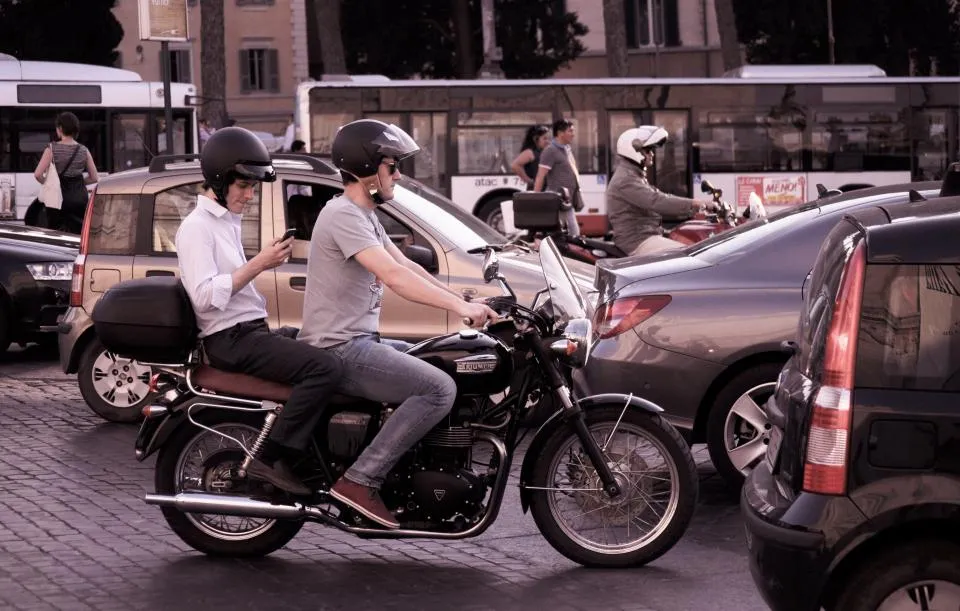
- Equipment. The included basic helmet has a replacement value of €50. Extra rented equipment, such as a full-face helmet, gloves or a jacket, is charged to the customer in case of loss, theft or damage.
Leaving mainland Portugal
By default, riding is restricted to mainland Portugal. Going to Spain, France or Italy is only allowed with the company's prior and express authorisation and with the corresponding insurance extension and travel assistance. Under the terms, the extension insurance for Spain costs €58 per 10 days. Breaching these limits is a serious breach of contract.
Your Europe reminds us that anyone who wants to drive a rented vehicle in more than one country should tell the company when booking, make sure they have the vehicle and insurance documents and know what to do in case of a breakdown. It is the same reasoning, applied to anyone heading up to Salamanca or down to Seville.
If there is an accident or a breakdown
Clause 8.1 asks for just one thing, and right away: contact RENT.MOTO.PT immediately and first, to activate the assistance procedure. If you cannot reach the shop, call the travel assistance number given in the policy, handed over with the motorcycle's documents. The customer must keep a phone number reachable throughout the rental.
In parallel, follow the usual procedure for any accident: safety first, an emergency call if anyone is injured, and a report to the police if another vehicle or third parties are involved. If the accident involves an uninsured driver or one who fled, Your Europe advises informing the police and the insurer, and explains that the national compensation body may step in when the other vehicle is uninsured or the insurer cannot be identified. The page Car insurance in another EU country also describes the compensation process: if liability is not contested and the damage has been assessed, the reasoned offer must arrive within 3 months of the claim.
Do not repair it, do not have it repaired and do not accept cash settlements on the spot without talking to the company. Clause 9.1 forbids any repair or mechanical modification without prior written authorisation.
If you disagree with a charge
It can happen that, on return, the company and the customer see the same scratch differently. The contract is governed by Portuguese law, the parties undertake to seek an amicable solution first and, if that fails, they may turn to alternative consumer dispute resolution bodies, such as CIAB and CNIACC, mentioned in clause 12.3. CIAB describes itself as a consumer dispute arbitration centre, and CNIACC as the consumer arbitration court; both have a complaint and information request form on their sites. There is also the electronic Livro de Reclamações (complaints book). Keep the hand-over checklist, the photos, the policy and the proof of deposit release: those papers are what any complaint rests on.
Frequently asked questions
Does third-party liability insurance cover damage to the motorcycle I rented?
No. It covers losses caused to third parties. Damage to the motorcycle itself, theft and total loss depend on the cover being shown as included in the listing or having been taken out as an add-on. Without it, the customer pays the repair costs or the market value.
Does the deposit work as insurance?
No. The deposit is a guarantee that the company can turn into a charge if there is damage, excesses, missing fuel, tolls or fines. If the damage exceeds the deposit and there is no own-damage cover, the customer remains liable for the full amount.
How long does the deposit take to come back to the card?
The company gives the release order within 24 hours of the return, after checking the motorcycle. The bank usually takes 7 to 15 working days to reflect the balance, and the regulatory maximum is 30 days. If it goes past 15 working days, talk to your bank with the proof in hand.
Can I take the motorcycle to Spain?
Only with the company's prior and express authorisation and with the insurance and travel assistance extension. Under the rental terms, the extension for Spain costs €58 per 10 days. Since the motorcycles have GPS, leaving without that authorisation is detected and counts as a serious breach of contract.
Ready to ride in Lisbon?
Book your motorcycle or scooter in a few minutes, with delivery across Lisbon.
View the fleetSources
- 1Renting a carhttps://europa.eu/youreurope/citizens/travel/driving-abroad/car-rental-abroad/index_pt.htm
- 2Car insurance in another EU countryhttps://europa.eu/youreurope/citizens/vehicles/insurance/accident/index_pt.htm
- 3CIABhttps://www.ciab.pt
- 4CNIACChttps://www.cniacc.pt
- 5electronic Livro de Reclamaçõeshttps://www.livroreclamacoes.pt
Motorcycle and scooter rental in Lisbon, Portugal.
All articles by the teamYou may also like
Serra da Arrábida by Motorbike: N379-1, Portinho, Viewpoints
Guide to the Serra da Arrábida by motorbike: the N379-1, Portinho, stops, which bike to choose and what to watch for. October 2026 prices.
Read more →
Evora from Lisbon by Motorcycle: One-Day Guide
Evora from Lisbon by motorcycle in one day: route, weather, which bike to rent, what to see and how to avoid surprises with the return time.
Read more →
Ericeira from Lisbon by Motorcycle: One-Day Route and Prices
Ericeira from Lisbon by motorcycle: two routes, surf beaches, Mafra, which bike to rent and what it costs. One-day guide with October 2026 prices.
Read more →