Riding a Motorcycle in Lisbon: Traffic, Cobbles and Parking
Riding a motorcycle in Lisbon: traffic, tram rails, cobbles, hills and parking, plus what the Highway Code and the city regulation say.
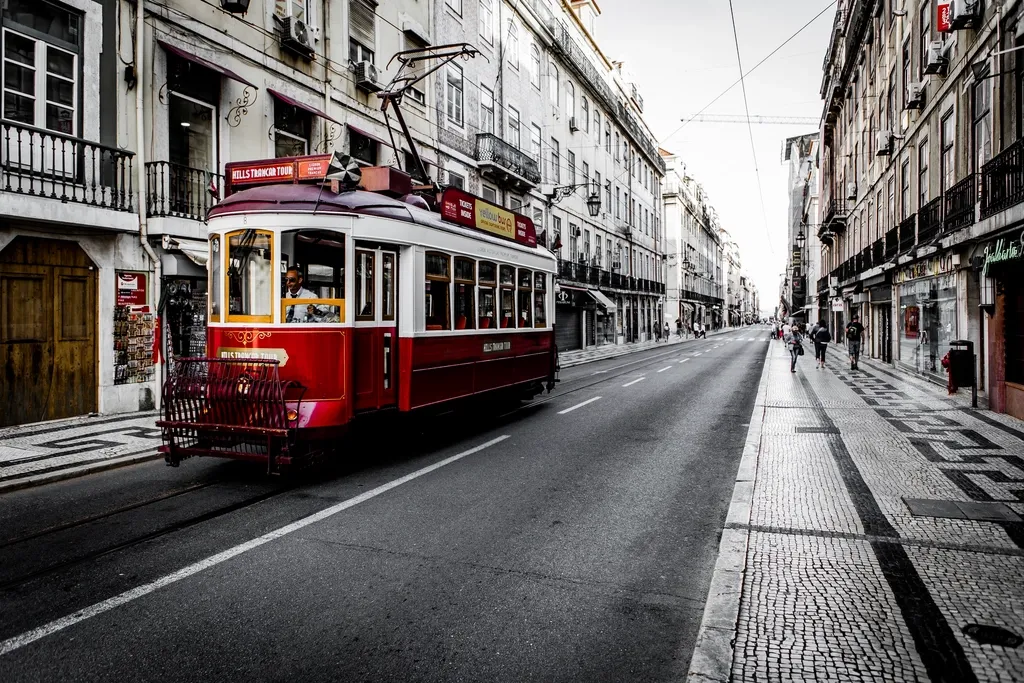
Lisbon has seven hills, tram rails sunk into the cobbles, streets that change direction every block and a car fleet that always seems bigger than the city. Anyone who decides on riding a motorcycle in Lisbon, or riding a mota, as it is called in Portugal, quickly finds that traffic is the smallest of the problems. The hard parts are the road surface, the parking and the small rules nobody explains to visitors. This guide brings together what the Código da Estrada (Highway Code) and the municipal regulation say, along with what you learn after a few weeks riding in the city.
In short:
- Stopping or parking on the pavement is prohibited by article 49 of the Código da Estrada, with a fine of €30 to €150, or €60 to €300 if it blocks pedestrians.
- An approved helmet, properly fitted and fastened, is mandatory for rider and passenger (article 82); the fine for not wearing it properly runs from €120 to €600.
- In Lisbon's limited-duration parking zones, motorcycles may only park in the areas reserved for them.
- A 125 cm³ scooter costs from €36 per day (November 2026 prices), with 400 km per day included.
- Rails, wet cobbles and manhole covers are the three places where you are most likely to slip; the rest is a matter of anticipation.
What changes when you ride a motorcycle in a city like Lisbon
Anyone used to open roads and European motorways tends to underestimate central Lisbon. Speeds are low, but the density of things happening at the same time is high: pedestrians crossing away from the crossing, delivery drivers, buses pulling in without warning, tourists with their eyes on their phones. On a motorcycle, all of this demands a different kind of attention from the one you spend on the open road. The good news is that the city forgives anyone who rides slowly and with a margin.
The simplest rule in the Código da Estrada that helps here is the one on road position. Article 13 requires you to ride on the right side of the carriageway, keeping enough distance from the verges or pavements to avoid accidents. In Lisbon, that distance is the one you leave from the cars parked in a row, because that is where open doors and people come from. A metre of clearance seems like a lot until the day a van door opens in front of your handlebars.
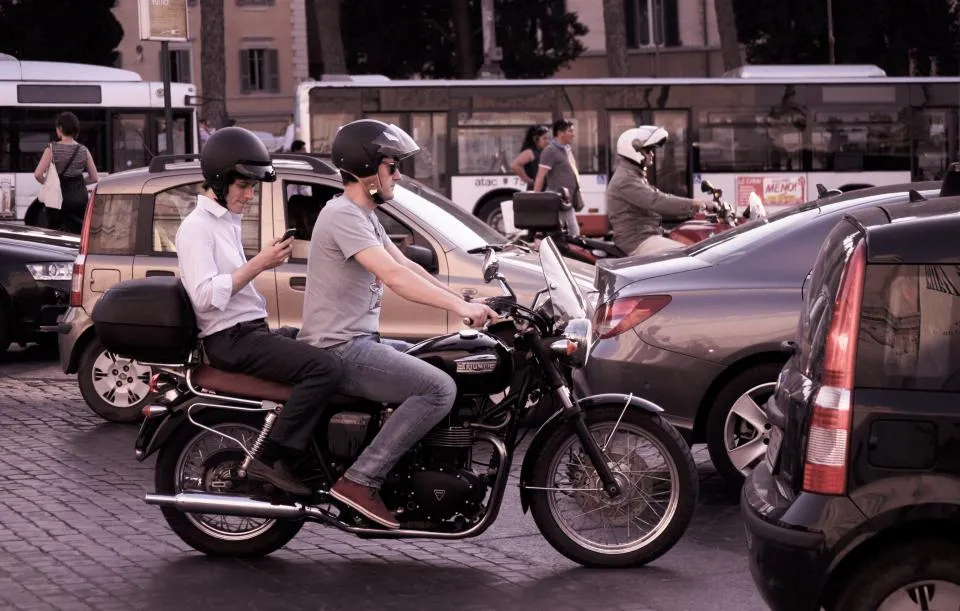
Traffic: queues, traffic lights and the mirror game
What surprises most is the uneven rhythm. There are stretches where you ride at 50 km/h with no obstacles and, around the next bend, a stationary queue that forms for no apparent reason. Always look two cars ahead of the one directly in front of you, not just at its bumper. When the car ahead brakes earlier than it should, there is almost always a pedestrian, a delivery van or a bus manoeuvring to explain why.
At traffic lights, the temptation is to filter between lanes to the front. The law is not the only criterion: visibility is another. A rider stopped beside a lorry's mirror is outside the driver's field of vision, and the green-light start is when the bumps happen. If you place yourself in the line of sight of the mirror of the car in front, and not beside it, you gain seconds of reaction time.
Cobbles, rails and trams
Portuguese cobbles are beautiful for people on foot and treacherous for people on two wheels. The stone, polished by decades of feet and tyres, loses grip with the first shower or with the dew of a cold morning. The practical rule is to treat any stretch of cobbles as if it were wet: gentle braking, minimal lean, no sudden acceleration mid-bend. The front brake, applied delicately, is still the most effective, but only if you avoid locking it.
Tram rails deserve a paragraph of their own. Wet steel is more slippery than wet asphalt, and the rail groove can catch a thin wheel if you cross it at a very shallow angle. The right move is to cross the rails as close to perpendicular as possible, with the motorcycle upright and without braking on top of them. On the rails, you never brake hard or change direction abruptly. The operator of these trams is Carris, and the lines run through the historic neighbourhoods where the streets are narrowest and the cobbles are oldest.
Staying behind a tram
Overtaking a tram stopped at a stop rarely pays off. People step down into the road, and the tram pulls away with an inertia that surprises whoever is behind. It is safer to stay behind, take a deep breath and wait ten seconds. The city is not in a hurry, and the five minutes saved are not worth a scare.
Hills and hill starts
Lisbon is made of slopes. For someone with little practice, the first start on a ramp at a red light is a good coordination test: clutch at the biting point, rear brake applied, a breath of throttle. On a motorcycle with a manual gearbox, the trick is to hold the rear brake until you feel the clutch bite, and only then release. On an automatic scooter, life is easier, because the variator does almost everything, but you still need to measure the throttle so you neither roll back nor lurch forward.
Parking on a slope has its own common-sense rules. With the motorcycle stopped on a downhill, you engage first gear and the side stand goes on the uphill side. On an uphill, it is the opposite: the stand goes on the downhill side and the motorcycle stays in gear. On a sloping surface of uneven cobbles, check that the stand is not resting on a soft joint. It is the classic cause of motorcycles falling over on their own.
Parking: the Código da Estrada and Lisbon's regulation
This is where most visitors go wrong, and it is where the law is clearer than you might think. Under article 49 of the Código da Estrada, it is prohibited to stop or park on pavements and other places meant for pedestrian traffic, on the carriageway next to a continuous line if the free distance is less than 3 m, and on crossings or within 5 m before them. The consolidated text is published in the Diário da República. The fine is €30 to €150, rising to €60 to €300 if the vehicle blocks pedestrians on the pavement or at crossings.
Bus and tram stops
The same provision prohibits stopping or parking within 5 m ahead and 25 m behind public transport stop signs, and within 6 m behind those signs when the vehicles run on rails. In Lisbon, where tram and bus stops are frequent, this rules out many of the spaces that looked free.
Limited-duration zones and motorcycle spaces
The Regulamento Geral de Estacionamento e Paragem na Via Pública de Lisboa (Lisbon's general regulation on parking and stopping on public roads) was published in the Diário da República of 2 March 2021 (Aviso n.º 3856/2021). Article 7 says that in limited-duration parking zones motorcycles may park exclusively in the areas reserved for them. In practice, this means a car space with a parking meter is not the right place for a motorcycle, even if it fits with room to spare. The regulation dates from 2021 and the city keeps changing tariffs and zones, so the safest thing is to check the signs on the spot before letting go of the handlebars.
The regulation also provides for restricted-access zones, where access is limited to certain classes of vehicle. Motorcycles appear among the classes allowed in, without prejudice to restrictions for shared vehicles. When you come across a barrier or a restricted-access notice in a historic neighbourhood, the golden rule is to stop, read and only then decide.
BUS lanes: what the law says and what the signs say
Article 77 of the Código da Estrada allows traffic lanes to be reserved for certain types of vehicle or for specific transport services, with a ban on all others, and sets a fine of €120 to €600 for anyone who breaks it. The same article, in paragraph 3, allows motorcycles and motorised tricycles to use those lanes. In practice, what decides is the sign next to the lane. In Lisbon there are lanes with different rules and hours, and the local signage counts for more than the memory of a café conversation. If in doubt, follow the normal flow and leave the lane to the bus.
Helmet, gloves and what to wear
Article 82 of the Código da Estrada requires motorcycle riders and passengers to protect their head with an officially approved helmet, properly fitted and fastened. The fine for not using, or incorrectly using, the safety devices provided for in the article runs from €120 to €600. In plain words: a fastened buckle matters as much as the helmet on your head. A RENT.MOTO.PT rental includes a basic helmet with a visor, with a replacement value of €50 in case of loss or damage, according to the general conditions of the rental contract.
In Lisbon, on a summer day at 30 degrees, it is tempting to set off in a T-shirt and sandals. Resist. A fall at 30 km/h on uneven cobbles leaves real marks. Gloves, sturdy trousers and closed shoes make the difference between an anecdote and a trip to A&E. In winter, the problem is the opposite: the damp and the wind off the Tagus chill your hands fast, and thin gloves are not enough.
Which motorcycle to choose for the city
For the city, weight and seat height count for more than horsepower. A 125 cm³ scooter fits anywhere, parks in less space and forgives less-than-clean braking and starts. A bigger motorcycle is more comfortable on the open road but demands more care in the alleys. These are the catalogue values for the scooters, with November 2026 prices and 400 km per day included:
| Model | Price per day | Licence | Deposit |
|---|---|---|---|
| Honda Vision NSC110 | €36 | A1 | €400 |
| Honda PCX125 | €46 | A1 | €600 |
| Yamaha NMAX 125 Tech MAX | €63 | A1 | €600 |
| BMW C 400 X | €72 | A2 automatic | €900 |
| Honda ADV 350 | €80 | A2 automatic | €800 |
For the 125 cm³ models, the minimum age is 18 and the licence can be A1, A2 or A, or else B with at least 25 years' experience (valid only in Portugal, according to the terms and conditions). Above 125 cm³, the minimum age is 21 and an A2 or A licence is required, as shown on each model's page. For the larger motorcycles, each motorcycle's page states the category and the requirements. The final checks, including riding experience, are done at handover.
If you want a scooter for riding a motorcycle in Lisbon and its surroundings, you will find all the options on the scooters page. If you prefer a manual-gearbox motorcycle for weekend trips out of the city, you can see the full range for riding a motorcycle in Lisbon with more power.
A typical day in the centre
A well-organised morning starts early. At nine, the traffic has thickened but not yet ground to a halt. You cross the city towards the Tagus, stop at a viewpoint for the first photo and head on to the historic neighbourhoods before the crowds. At midday, the motorcycle stays in a legal space and you have lunch on foot. In the afternoon, you come back along the riverfront, where the views make up for the rush hour. If the plan includes leaving the city, riding to Sintra from Lisbon is the most natural escape.
Motorcycle pick-up is at the shop in Sobreda, every day from 09:00 to 19:00. If you prefer to receive the motorcycle at the airport or at home, you can ask for delivery, which is a paid service. Booking requires 30% of the amount, and the deposit is held on a credit or debit card, being released within 5 working days after return.
Official information and where to check
The traffic rules and fines are in the Código da Estrada, which you can consult in the Diário da República. The Autoridade Nacional de Segurança Rodoviária (National Road Safety Authority) is the body that gathers official information on enforcement and road safety. For the licence and its categories, the source is IMT. The city's parking rules change from time to time, so a quick check before a longer stay avoids pointless fines.
Frequently asked questions
Can I park my motorcycle on the pavement in Lisbon?
No, when it occupies a place meant for pedestrian traffic. Article 49 of the Código da Estrada prohibits stopping or parking on pavements, with a fine of €30 to €150, or €60 to €300 if it blocks pedestrians. Use the areas reserved for motorcycles or a car park.
Do I need to pay for motorcycle parking?
In limited-duration parking zones, Lisbon's 2021 regulation says motorcycles may only park in the areas reserved for them. The applicable tariffs vary by zone and by date, so read the sign next to the space before leaving the motorcycle.
Can I ride in the BUS lane?
Article 77(3) of the Código da Estrada allows motorcycles to use reserved lanes, but the local signage prevails. If the sign does not allow it, the fine of €120 to €600 applies. If in doubt, stay in the normal lane.
What is harder to handle: cobbles or rails?
Both call for the same thing: low speed, an upright motorcycle and gentle braking. Rails are more dangerous on rainy or dewy days, and polished cobbles are worse when damp. At least 10 minutes of getting used to it in a quiet neighbourhood helps before you enter the centre.
What time is traffic lightest for motorcycle riders?
Outside rush hours, the city is much more fluid, and early morning is the calmest time for anyone still building confidence. If the plan involves leaving the city, remember that the rental includes 400 km per day and that each additional kilometre costs €0.49, according to clause 5.1 of the terms and conditions.
Ready to ride in Lisbon?
Book your motorcycle or scooter in a few minutes, with delivery across Lisbon.
View the fleetSources
- 1Carrishttps://www.carris.pt
- 2Diário da Repúblicahttps://diariodarepublica.pt/dr/legislacao-consolidada/lei/2013-116041830-116043213
- 3Diário da República of 2 March 2021https://files.dre.pt/2s/2021/03/042000000/0033000364.pdf
- 4Autoridade Nacional de Segurança Rodoviáriahttps://www.ansr.pt
- 5IMThttps://www.imt-ip.pt
Motorcycle and scooter rental in Lisbon, Portugal.
All articles by the teamYou may also like
Honda NC750X Review: Renting It in Lisbon
Honda NC750X review: how it rides in town and on the road, who it suits, price, deposit and the licence needed to rent it in Lisbon.
Read more →
Motorcycle rental insurance: what it covers, what it doesn't, excess
Motorcycle rental insurance in Lisbon: what third-party, own damage and theft cover, the excess, and how it ties in with the deposit.
Read more →
Serra da Arrábida by Motorbike: N379-1, Portinho, Viewpoints
Guide to the Serra da Arrábida by motorbike: the N379-1, Portinho, stops, which bike to choose and what to watch for. October 2026 prices.
Read more →