
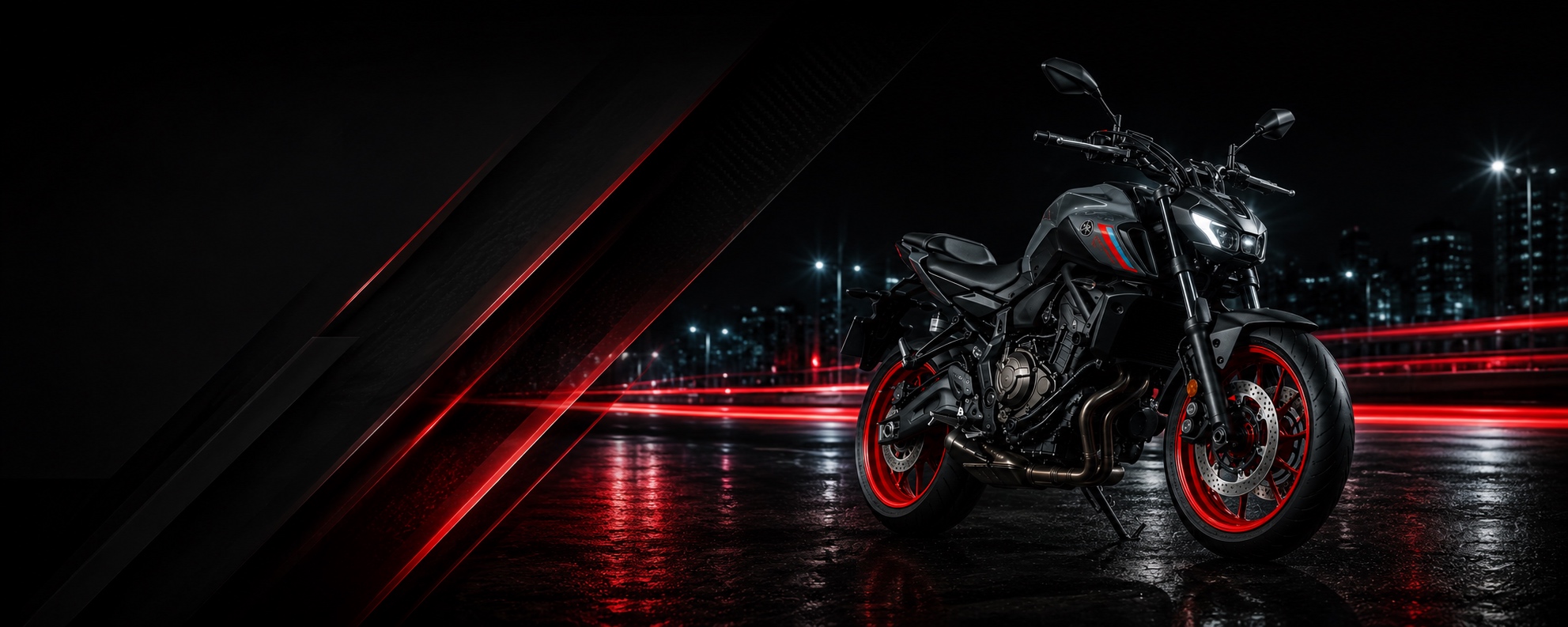
The revolution within the highly demanding two-wheeled world rarely occurs in a quiet, subtle, or predictable manner. The moment Yamaha unleashed the fierce MT (Master of Torque) family onto the global stage—spearheaded by the iconic “Dark Side of Japan” campaign—the middleweight naked motorcycle landscape was altered forever. Far beyond its status as a massive, record-breaking sales triumph across Europe, the Yamaha MT-07 stands out as an undeniable marvel of mechanical engineering. It is purposefully built to serve up raw emotional excitement, seamless accessibility for less experienced riders, and class-leading dynamic handling. In this highly comprehensive, deeply technical, and strictly no-nonsense guide, we will break down the MT-07 millimeter by millimeter.. We will deeply explore the pulsating rhythm of its mechanical heart, scientifically analyze its dynamic chassis behavior under heavy stress, detail its top-tier suspension components, and definitively answer the most pressing technical questions that riders constantly ask before turning the ignition key and awakening the highly acclaimed CP2 engine.
What is the displacement of the MT-07?
The frequent, widespread confusion regarding the exact engine displacement of many modern motorcycles often stems directly from the rounded-up commercial names that brands adopt for pure marketing purposes. To directly, clearly, and factually answer those avidly searching for “mt 07 que cilindrada es” or “qual a cilindrada da mt 07“: the Yamaha MT-07 features an exact, mathematically precise engine displacement of 689 cc (cubic centimeters).
However, that raw volumetric number alone does not tell even half of the fascinating mechanical story behind this powertrain. This specific engine, officially baptized by the engineers in Iwata as the CP2 (Crossplane 2), is a highly advanced liquid-cooled parallel-twin. It features Dual Overhead Camshafts (DOHC) pushing 4 valves per cylinder. The true, brilliantly guarded, and patented secret to its mechanical magic lies directly within its uniquely designed 270-degree crankshaft. Unlike older, traditional parallel-twin engines (which typically utilized 180 or 360-degree crankshafts, resulting in either annoying buzzing vibrations or a highly monotonous, flat power delivery), Yamaha’s revolutionary crossplane architecture intentionally creates an irregular, asymmetrical firing order (igniting at 270° and then again at 450°).
This highly intentional mechanical ignition asymmetry perfectly mimics the dynamic torque delivery, the deep, guttural, and barking exhaust note, and, above all else, the vastly superior mechanical traction of a 90-degree V-Twin engine, but it accomplishes this while occupying significantly less physical space within the steel frame. The highly practical, real-world result for the rider is an immediate, visceral delivery of power, a connection that feels almost entirely telepathic between the ride-by-wire throttle and the rear tire, and the dramatic, engineered elimination of what is known as “inertial torque.” This specifically allows the rear tire to continuously find crucial mechanical grip even on surfaces with a heavily reduced friction coefficient, such as wet winter asphalt or the slippery cobblestone streets of historic European villages. It is for this exact, brilliant engineering reason that the unbeatable 689 cc engine of the MT-07 was subsequently adapted by Yamaha to power other massive global sales hits, such as the unstoppable Ténéré 700 adventure bike, the Tracer 7 sport-tourer, and the track-focused R7 supersport.
What is the torque of the MT-07?
The aggressive, imposing moniker “Master of Torque” was absolutely not chosen on a mere whim by a bored advertising department; it is a solid declaration of mechanical intent. When motorcycle enthusiasts exhaustively ask “qual o torque da mt 07“, the official, homologated factory numbers clearly and proudly indicate an impressive 67 Nm (6.8 kgf.m) achieved at a highly accessible 6,500 rpm. The absolute peak horsepower of the entire unit is officially rated at 73.4 PS (54 kW), reached at the peak of 8,750 rpm.
In a strictly mechanical analysis focused on real-world riding dynamics, the raw torque value is immeasurably more important for daily city commuting, fighting through heavy traffic, and for long trips carrying a pillion passenger on winding national roads than the highly publicized peak horsepower figure. The absolute peak torque of the MT-07 is reached at a significantly lower engine speed (6,500 rpm) than its inline-four competitors, and the torque curve itself is meticulously mapped to be incredibly flat, broad, and meaty. In practical terms, this means that starting from an incredibly low 3,000 rpm, the rider already has over 80% of the engine’s total maximum pulling force immediately available at their fingertips.
Out on the open road, this translates directly into an almost total absence of the annoying need to constantly tap dance on the gear shifter. Whether you are carefully planning to execute a rapid, decisive overtake on a steep, blind incline in the magnificent Douro region, or simply powering aggressively out of a tight, slow corner on a high mountain pass in the Serra da Estrela, you merely need to roll on the right grip. The CP2 engine pushes the motorcycle forward with aggressive, muscular linearity that remains completely predictable. Its highly refined fuel injection system prevents jerky throttle responses, making it undeniably one of the most thrilling yet simultaneously safe machines to ride in its entire displacement class, regardless of whether you are a newly licensed novice or a hardened veteran pilot with decades of asphalt under your belt.
High-RPM Dynamics: What is the top speed of the MT-07?
Being proudly designated as a hyper naked motorcycle entirely stripped of unnecessary plastic fairings, wind-tunnel aerodynamic penetration is, by definition, absolutely not its strongest attribute. However, the sheer mechanical health of its punchy engine heavily compensates for this physical factor. The specific question “qual a velocidade máxima da mt-07” has an empirical answer that naturally fluctuates slightly depending on current atmospheric conditions (heavy headwinds), the physical weight of the fully geared rider, the incline of the road, and the specific year of manufacture (largely due to increasingly restrictive Euro 5 emission norms that require larger, heavier catalytic converters). Nevertheless, the true, GPS-verified top speed of the Yamaha MT-07 sits comfortably in the solid range of 210 to 215 km/h (approximately 130 to 133 mph).
The energetic twin-cylinder engine possesses more than enough breath to rapidly and violently push the digital TFT speedometer up to 180 km/h, gear after gear, without any hint of hesitation. Exactly beyond that specific point of resistance, the heavy aerodynamic drag caused by the total absence of a protective front windscreen, the flat headlight design, and, primarily, the rider’s chest acting as an open parachute exposed to the hurricane-force wind, makes the climb to the absolute top speed progressively much slower. It is mechanically imperative and vital to note that the specific design of the high-tensile steel diamond frame and the aggressive steering geometry (featuring a tight 24.5-degree caster angle and a very short wheelbase) were scientifically engineered to heavily promote extreme agility and telepathic changes of direction in low and medium-speed twisty corners, and absolutely not to provide unbreakable, freight-train directional stability at highway speeds massively exceeding the legal limit. Above 160 km/h, the front end of the bike can become slightly nervous and light, an entirely intrinsic and expected characteristic of a motorcycle whose weight distribution is purposely focused on maximizing the fun factor, wheelie capability, and low-speed urban maneuverability.
What is the fuel economy of the MT-07?
Advanced Japanese engineering truly shines with the greatest intensity exactly when it successfully achieves the thermodynamic miracle of marrying aggressive sports performance with incredible fuel economy. For those meticulously planning a massive, multi-day road trip from the extreme north to the far south of the country, and asking the vital question “quanto a mt 07 faz por litro“, the remarkable thermal efficiency of the CP2 engine block is indisputably one of its greatest and most highly underestimated technical virtues.
Under mixed daily riding conditions (battling through urban stop-and-go traffic and enjoying fast, flowing national roads) at a smooth, intelligent pace, the MT-07 consistently registers astonishing averages of 22 to 24 km/l (which directly equates to approximately 4.1 to 4.5 liters consumed per 100 kilometers traveled, or roughly 52 to 57 US MPG). If your riding style becomes extremely sporty and aggressive—braking very late, accelerating violently out of corners, and constantly exploring the redline of the rev counter—this excellent value can predictably drop to around the 17 to 18 km/l mark.
Yamaha’s highly advanced electronic fuel injection system has been relentlessly reprogrammed to absolutely maximize gasoline atomization and combustion efficiency at partial throttle loads. The deeply sculpted fuel tank, aesthetically designed to perfectly accommodate the rider’s gripping knees, holds a total capacity of 14 liters. When ridden at a relaxed, legal touring pace, the MT-07 confidently offers a theoretical maximum range that comfortably exceeds the 300-kilometer (186 miles) mark long before the dreaded reserve fuel light urgently demands a pit stop at the gas station. To rigorously assess environmental compliance, Yamaha heavily subjects its engines to the strict WLTP testing cycle, proudly guaranteeing that the heavy adoption of anti-pollution Euro 5 regulations has absolutely not strangled the innate, brilliant efficiency of this twin-cylinder masterpiece.
How much does an MT-07 weigh?
In the unforgiving world of automotive and motorcycle engineering, one of the most immutable laws of physics applies brutally: unnecessary, dead weight is the mortal enemy of rapid acceleration, sheer braking power, tire longevity, and cornering agility. Knowing accurately “quanto pesa uma mt 07” is the absolute first step to deeply understanding exactly why this specific motorcycle is so universally revered and highly praised by professional test riders worldwide.
The most recent iteration of the Yamaha MT-07 presents an official wet weight (curb weight) on the scales of a mere, exact 184 kg (406 lbs). This rigorously means that the motorcycle weighs exactly 184 kilograms while already fully equipped with its heavy lead-acid battery, all vital operating fluids filled to their maximum levels (synthetic engine oil, radiator coolant, hydraulic brake fluid), and with its 14-liter fuel tank completely topped off with unleaded gasoline, 100% ready to hit the road.
This highly impressive featherweight status within the fiercely competitive middleweight segment is successfully achieved through drastic, clever design decisions: a minimalist frame constructed from high-tensile steel tubing that intelligently utilizes the actual engine block itself as a stressed structural load-bearing member, saving dozens of kilos in unnecessary metal gusseting. The lightweight 10-spoke cast aluminum alloy wheels drastically reduce rotational unsprung mass, which, combined with the premium Michelin Road 5 sport-touring tires, allows the traditional 41 mm KYB telescopic front suspension forks to react much faster and far more compliantly to the violent, harsh imperfections frequently found on Portuguese asphalt.
During heavy deceleration, the significantly reduced overall mass of the vehicle incredibly optimizes the arduous work of the new, massively upgraded dual 298 mm petal-shaped front brake discs. These are now violently and powerfully actuated by potent axial-mount four-piston brake calipers, heavily backed by a state-of-the-art ABS system that completely prevents dangerous wheel lock-up during panic stops. The magical engineering combination of a curb weight of just 184 kg with a punchy 67 Nm of torque creates an absolutely formidable power-to-weight ratio, rendering the motorcycle ridiculously agile during rapid, violent changes of direction (chicanes) and extremely docile, balanced, and easy to maneuver at walking speeds in heavy city traffic.
Technology and Ergonomics: Comfort for the Long Haul
The most recent iterations of the MT-07 (from 2021 onwards, and specifically the highly updated 2024 model) have taken a massive, quantum leap regarding onboard rider technology. The older, basic monochrome LCD dash has completely given way to a brilliant, 5-inch full-color TFT display, highly legible even under the blinding, direct sunlight of the scorching Iberian summer. This advanced panel not only displays speed, gear position, and fuel levels with immense, crystal-clear sharpness, but it also allows for total Bluetooth connectivity with the rider’s smartphone through the free Yamaha MyRide application. This smart app allows riders to digitally log travel routes, record maximum lean angles in corners, track top speeds, and it even actively notifies the dashboard screen about incoming phone calls and text messages.
Regarding ergonomics, the crucial “rider triangle” (physically formed by the handlebars, the seat, and the footpegs) has been studied and refined to absolute exhaustion. The tapered aluminum handlebars were slightly widened by roughly 30 mm in recent versions to offer a significantly larger leverage arm and vastly more control during tight, slow maneuvers. The seat, highly accessible and placed at a friendly 805 mm from the ground, combined with an extremely narrow central fuel tank junction, allows riders of much shorter physical statures to easily plant the soles of both feet firmly flat on the asphalt, transmitting an unbreakable feeling of absolute confidence when stopping at slick traffic lights or pausing on steep mountain inclines.
If you are considering the Yamaha MT-07 as your first middleweight motorcycle, you are not alone. According to our analysis, the MT-07 was named the best 600cc motorcycle for beginners in 2025, thanks to its excellent balance between accessible power, low weight (just 184 kg), and intuitive, predictable handling. It is perfect both for those taking their first steps in the world of middleweight naked bikes and for more experienced riders looking for pure fun on Portuguese roads.
The Logical Choice for Exploring Portugal
To truly comprehend the deep, holistic, and highly passionate engineering of the Yamaha MT-07 is to realize that it completely transcends its basic mechanical function; it is not merely a cold, lifeless mode of transportation, it is a genuine, responsive extension of the rider’s own body and will. If you are currently, eagerly planning your highly anticipated summer holidays or a thrilling weekend getaway to completely break the monotony of daily routine, making the sensible decision regarding a motorcycle rental heavily demands the strict selection of a machine that, on one hand, will absolutely not dangerously intimidate you on unknown, blind, and narrow secondary country roads, but that, on the other hand, possesses enough raw pedigree, mechanical charisma, and horsepower to not bore veteran riders accustomed to massive 1000cc superbikes.
It is exactly at this formidable, golden equilibrium point that Yamaha’s middleweight champion comfortably and solidly resides in total isolation. The miraculous, rubber-band elasticity of the CP2 engine easily and quietly forgives the clumsiest gear selection errors made by tired riders, its ultra-low overall weight makes manual parking on steep inclines and slippery cobblestones in historic villages incredibly easy, and its admirable, highly frugal fuel consumption heavily protects your wallet at the pumps, allowing you to happily spend your vacation budget on the fabulous local Portuguese gastronomy instead. The Yamaha MT-07 absolutely does not promise at any moment to be the fastest motorcycle on the planet, nor the most heavily laden with intrusive electronic rider aids, but it flawlessly and undeniably delivers on its difficult promise to be one of the purest, most authentic, and endlessly fun riding tools ever created by man.
Prepare your protective gear, carefully choose your scenic itinerary, and fully trust this “Master of Torque” to brilliantly transform every single simple corner into a totally unforgettable, high-adrenaline memory.