
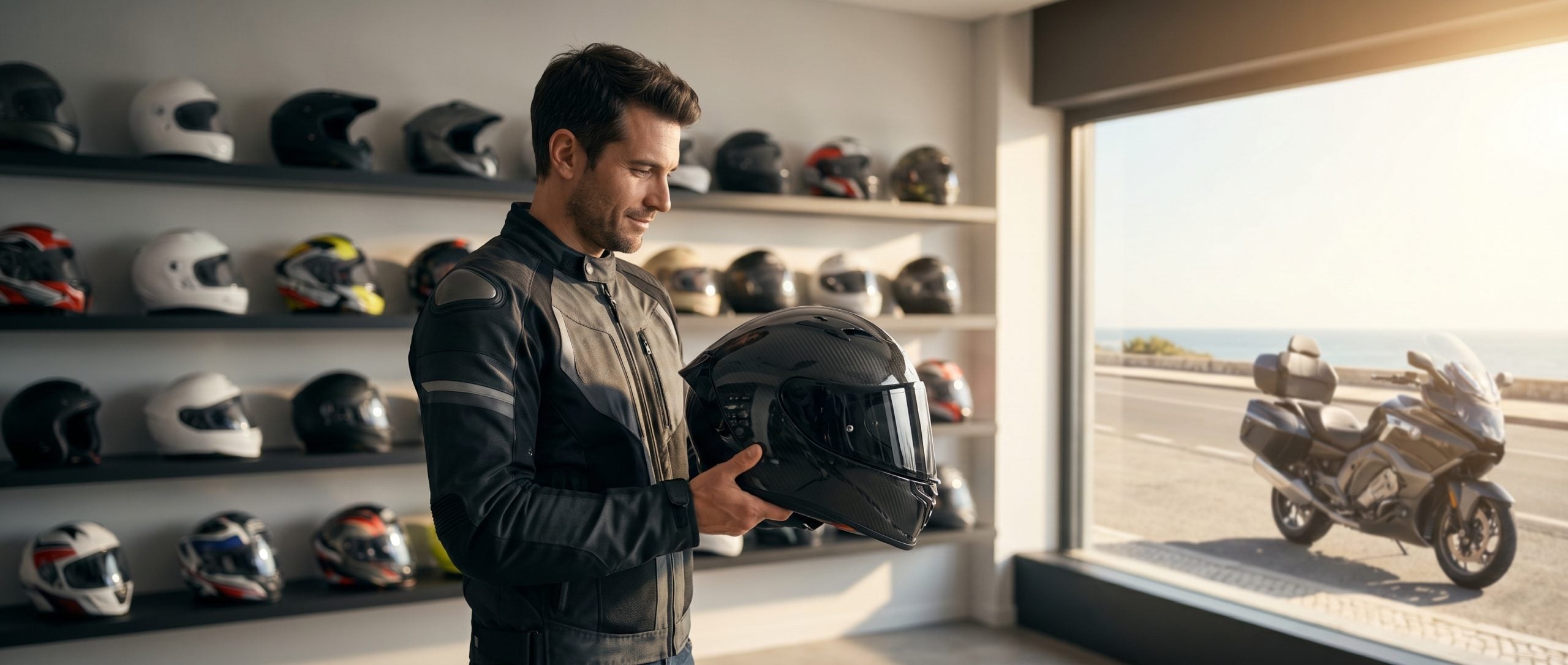
Let’s start with a universal and undeniable truth in the two-wheeled world: your head is, by a massive margin, your most valuable asset. You might own the absolute fastest motorcycle on the market, an aftermarket exhaust system with the most aggressive, roaring sound, or the most stylish vintage leather jacket money can buy. But the exact moment gravity suddenly decides to play a cruel trick on you, it is that simple “bucket” of fiberglass and styrofoam that dictates whether you will be going home at the end of the day to have dinner with your family.
Choosing and buying a helmet is a sacred, vital ritual for any motorcyclist. However, with the massive explosion of e-commerce, the dangerous proliferation of obscure Asian white-label brands, and the sad disappearance of some traditional neighborhood gear shops, a very practical question haunts both newly licensed riders and grizzled road veterans alike: where on earth should you buy motorcycle helmets nowadays? And, perhaps even more importantly, how can you absolutely guarantee that you aren’t just throwing your hard-earned money in the trash or, even worse, fatally compromising your personal safety?
In this exhaustive, deeply detailed guide, passionately written by the RENT.MOTO.pt team—who devour miles of rough asphalt every single weekend—we are going to bypass the standard, boring corporate sales pitches. We are going to completely dissect the Portuguese and European gear markets, explain exactly what hidden details to look for, point out where the absolute best deals hide, warn you about the severe dangers of the second-hand market, and teach you how to properly measure your skull so you don’t end up with a blinding migraine after your first hour-long trip.
1. The Anatomy of the Decision: What Are You Actually Buying?
Before you even think about opening a new tab in your web browser or putting the key in the ignition to drive down to a local gear store, you absolutely must understand what physically separates a cheap 100-euro helmet from a premium 1000-euro flagship model. Many uneducated buyers mistakenly assume they are just paying a massive premium for a colorful logo or a MotoGP rider’s replica paint job, but the hidden chemical and structural engineering behind these pieces is truly fascinating.
The Outer Shell (Your Armor): The cheapest budget helmets you will find in big-box generalist supermarkets (yes, those massive stores that sell everything from fresh lettuce to basic motorcycle gear) are almost always made of injected thermoplastic resin or basic polycarbonate. Are they technically safe? Yes, they manage to pass the bare minimum legal tests. But they are inherently heavy, and their physical capacity to safely disperse the massive kinetic energy of a sharp, concentrated impact is significantly limited. When you boldly move up the price ladder (into specialized gear shops), you enter the advanced world of fiberglass, multi-fiber composites (like Kevlar blends), and, sitting proudly at the absolute top of the food chain, pure woven carbon fiber. Carbon fiber is not just there to look aesthetically stunning; it offers an astonishing level of structural rigidity while maintaining a true featherweight profile. This aggressively saves your neck muscles from severe fatigue during long highway journeys and, crucially, reduces the dangerous rotational inertia of your skull during a chaotic, tumbling crash.
Homologation and Safety Standards: Never, under any circumstances, buy a helmet anywhere that does not have the official European homologation label securely stitched into the chinstrap. Currently, the European market is undergoing a massive, highly critical transition. The aging ECE 22.05 safety standard has been officially replaced by the incredibly rigorous ECE 22.06 standard, meticulously coordinated by the UNECE (United Nations Economic Commission for Europe). This brutal new standard legally forces manufacturers to physically test their helmets across 18 completely different impact points (compared to only 6 in the outdated previous standard). It also now includes vital oblique impact testing designed specifically to simulate rotational brain damage, as well as brutal high-speed projectile penetration tests for the visors.
For riders who are rightfully obsessed with maximum safety, you can and absolutely should cross-reference the store’s marketing claims with strict independent testing entities. The highly respected British scheme, SHARP (Safety Helmet Assessment and Rating Programme), anonymously purchases helmets directly from retail stores and subjects them to a battery of brutal physical tests, ultimately awarding them a clear rating from 1 to 5 stars. Another global standard of absolute excellence, specifically focused on surviving extreme high-G forces, is the Snell Memorial Foundation in the United States, or the absolute pinnacle track homologation managed strictly by the FIM (Fédération Internationale de Motocyclisme).
2. The Great Debate: Brick-and-Mortar Stores vs. Online Shopping
We have now arrived at the very core of the issue. With a shiny credit card in your hand, the entire digital world is your personal shopping mall. But purchasing a highly technical safety helmet is absolutely not as simple as buying a cheap silicone case for your mobile phone.
The Magic and Absolute Necessity of Physical Stores
In all honesty, if this is your very first time buying a motorcycle helmet, or if you are transitioning to a brand you have never worn before in your life, visiting a physical brick-and-mortar store is mandatory. In Portugal, we are incredibly lucky to have excellent physical stores staffed by employees who are deeply passionate motorcyclists themselves (such as Capacetes.pt, Motovest, physical Iberian branches of FC-Moto, or dozens of highly dedicated local dealerships scattered from Braga down to Faro).
- The Shape of Your Head: This is the best-kept, most important secret in the entire helmet industry. Your head is absolutely not a perfect, symmetrical sphere; it can be classified as a “Long Oval,” an “Intermediate Oval,” or “Round.” A size “M” helmet from the premium Japanese brand Shoei (which typically leans toward an intermediate oval shape) might fit you like a custom-made glove, while a size “M” from the legendary Italian brand Arai (depending on the specific shell model) might create a terrifying, localized pressure point squarely on your forehead that will literally make you cry in pain after just 40 minutes on the road. In a physical store, you can sit down and try them both on for half an hour.
- The “Chipmunk Cheek” Test: In a reputable store, a knowledgeable staff member will teach you that a brand-new helmet must fit incredibly tight. It needs to squeeze your cheeks so aggressively that you almost bite the inside of your own mouth if you attempt to speak. The interior foam comfort pads will naturally compress and yield about 15% to 20% after roughly a month of sweaty use. If you mistakenly buy a helmet online that feels “super comfortable and roomy” on the very first day, after a month of riding, it will be dangerously loose, violently buffeting in the wind and offering zero protection.
Very frequently, when a tourist arrives in the beautiful country of Portugal and immediately needs reliable riding gear, they search for a highly trusted motorcycle rental service. Excellent, premium companies always provide properly ozone-sanitized gear in various sizes. However, the true, hardcore purists of the open road always prefer to stop by a physical gear shop in Lisbon or Porto to personally acquire their own dedicated “armor” before initiating their epic Iberian journey.
The Convenience and Unbeatable Prices of Online Stores
Once you know exactly, with absolute certainty, what your preferred brand is, the specific internal shape of your skull, and your exact size (for example, you know you are a perfect “L” in AGV helmets), e-commerce becomes an absolute paradise for jaw-dropping bargains.
European digital giants like Motocard, XLMoto, FC-Moto, or Louis Motorrad operate massive logistical warehouses the size of professional football pitches. They possess an immense purchasing power that completely crushes the retail prices of small local shops.
- The Massive Advantages: You get immediate access to highly exclusive models, limited-edition runs (like exact replica helmets of famous racers), and deep “Outlet” or “Clearance” sections (where they aggressively clear out old stock). Here, you can easily buy last year’s top-tier, flagship helmet with an astonishing 40% or 50% discount.
- The Hidden Risks: The complex return policies. If you make a mistake with the size, you will have to carefully repackage the helmet, pay expensive international return shipping fees out of your own pocket to send it back to Germany or Spain, and then frustratingly wait weeks for a refund or exchange. Furthermore, there is the highly invisible risk of shipping transport. A fragile helmet carelessly thrown through the air by a rushed delivery courier can easily suffer invisible micro-cracks in the internal EPS (styrofoam layer) without the hard outer cardboard box showing any obvious external damage.
3. The Dangerous Minefield of Used Helmets (OLX, Vinted, eBay)
This is one specific point where we cannot afford to be tolerant, polite, or diplomatic. Our answer to the frequent question “where should I buy second-hand motorcycle helmets?” is very simple and definitive: Nowhere. Never, ever do it.
We completely understand the financial appeal. You see a gorgeous, glossy carbon fiber helmet listed on OLX or Vinted for merely a third of its original retail price. The desperate seller swears up and down in the description that it was “only used twice,” “never dropped,” and they are “only selling because they sold the bike.”
The fatal problem lies entirely in the unforgiving chemistry and physics involved. As we explained earlier through the strict safety protocols of the Snell Foundation, the crucial shock-absorbing material glued inside the helmet (the EPS) was meticulously designed to violently crush and permanently compress in order to dissipate kinetic energy during an impact. Once that dense styrofoam is compressed, it never, ever regains its original shape or protective properties. A helmet could easily have fallen off a high garage shelf onto a hard concrete floor, suffering critical, microscopic damage to its internal structure, without leaving a single visible scratch or chip on the shiny exterior clear coat. When you buy a used helmet from a complete stranger on the internet, you are literally trusting your life to someone you do not know. It is the exact, terrifying equivalent of buying a used parachute that has already been deployed, with absolutely zero guarantees that it was folded and repacked correctly. Your life and your brain are worth infinitely more than the 100 euros you are trying to save.
4. How to Choose the Right Type in the Store
When you finally step into the store (whether physical or virtual), you will be confronted with several distinct “tribes” of helmets. Where you should invest your money depends entirely on your specific riding style.
- Full-Face: This is the absolute golden standard of global safety. The chin bar is a solid, fixed, and continuous piece seamlessly integrated with the rest of the outer shell. Statistics show that roughly 45% of all impacts during severe motorcycle crashes occur directly in the jaw/chin area. If you demand maximum physical safety, superior aerodynamic stability at high speeds, and the best acoustic noise isolation, this is the only logical choice.
- Modular (Flip-Up): The entire front chin bar can be unlocked and lifted on hinges. This is the absolute favorite choice for long-distance touring riders, urban couriers, and motorcycle police forces. It allows you to comfortably refuel the bike, ask a pedestrian for directions, or drink water without having to take your gloves off and unbuckle the chinstrap. However, they are generally heavier due to the complex locking mechanisms and noticeably noisier due to the air gaps. Important note: only legally ride with the chin bar open if the helmet explicitly has dual homologation (marked as P/J).
- Adventure (Dual-Sport): A brilliant hybrid mix between an aggressive motocross helmet and a standard full-face. It features a long upper peak to block blinding sun and flying mud, combined with a massive, wide clear visor for comfortable highway riding. It is the functional and aesthetic choice of choice for owners of large Trail bikes (like the BMW R1250 GS or Honda Africa Twin).
- Open-Face (Jet / 3/4): Aesthetically pleasing for the vintage crowd, and wonderfully cool for slow summer riding in the city, but inherently dangerous. They leave your face, teeth, and jaw completely exposed to the harsh elements, flying insects, kicked-up rocks, and, tragically, the abrasive asphalt in the event of a fall. They should be strictly restricted to very short, low-speed urban commutes on scooters.
5. The Rental Perspective and Trip Preparation
A highly frequent situation on the beautiful, scenic Portuguese roads (like the famous N2 route or the stunning Vicentine Coast) involves international two-wheeled tourism. Currently, top-tier motorcycle rental operators have drastically and positively changed their approach to safety gear.
In the dark past, renting a bike often meant reluctantly strapping on an old, heavily scratched helmet that smelled strongly of the sweat of dozens of previous riders. Today, reputable services include the excellent option to rent premium, ozone-sanitized gear. However, our strong recommendation as hardcore enthusiasts is this: if you actively plan to make long, epic journeys and frequently rent motorcycles around the world, investing heavily in your own premium helmet and carrying it onto the airplane with you (as an oversized carry-on) is the most hygienic, comfortable, and safe decision you can possibly make. Riding with your own helmet, which perfectly matches the exact shape of your skull, already equipped with your own Bluetooth intercom system and a pristine, scratch-free Pinlock (anti-fog lens), completely transforms a potentially painful trip into an absolute luxury experience.
6. How to Measure Your Head Before Buying (The DIY Guide)
If you have bravely decided to take the risk and buy from a massive online store to grab an excellent discount, you absolutely must do your homework first. Grab a flexible seamstress measuring tape (if you don’t have one, just use a long shoelace and then measure the shoelace against a rigid metal ruler).
- Place the measuring tape approximately 2 centimeters (about an inch) directly above your eyebrows.
- Pass the tape securely around the sides of your head, slightly above your ears.
- Wrap it around the absolute most prominent, bulging part at the back of your skull (the occipital bone).
- Ensure that the tape is perfectly level all the way around. The number you get in centimeters (for example, 58 cm) is your baseline head size. In the vast majority of European helmet brands, 57-58 cm strictly corresponds to a size “M”, and 59-60 cm corresponds to a size “L”. But you must always cross-reference this specific value with the official Size Chart of the specific brand you want to buy, because an “M” in a Shark helmet might fit completely differently than an “M” in an HJC helmet.
7. When Should I Go Back to the Store to Buy Another One? (The End of Life)
Finally, it is crucial to note that the complex journey of “where to buy” absolutely does not end at the moment of the credit card transaction. A motorcycle helmet has a natural, organic expiration date, regardless of whether it ever suffers a crash or not.
The strict rule of the global safety industry is remarkably clear: a basic polycarbonate helmet must be thrown away and replaced every 3 to 5 years of active use, and a premium composite fiberglass/carbon helmet every 5 to 7 years. The natural, acidic oils from our scalp, our salty sweat, the baking heat of the summer sun, soaking rain, and constant UV radiation literally cook the internal glues and chemically shrink the protective styrofoam liner over time. After five solid years of daily commuting, the internal adhesives weaken significantly, and the EPS becomes hard and brittle like stale bread, completely losing its vital capacity to safely absorb an impact. When your trusty helmet starts feeling suspiciously loose on your head at highway speeds, or you notice the fabric comfort liner slowly crumbling into black dust on your forehead, it is officially time to open this article back up and actively search for your next gear store.
A helmet does not last forever, no matter how premium it is. The internal materials (especially the EPS foam) degrade over time due to sweat, UV exposure, heat, and regular use. That’s why it’s essential to know exactly when it’s time to replace your helmet.
We strongly recommend reading our complete guide: When to change your motorcycle helmet?
Respecting the helmet’s lifespan (generally 5 years of use or 7 years from the manufacturing date) is just as important as choosing a good new model.
Conclusion and Your Next Destination
Knowing exactly where, how, and why to buy a specific motorcycle helmet is an important rite of passage that deeply attests to your maturity and your profound respect for the absolute privilege of riding a two-wheeled machine. Whether you strongly opt for the highly personalized experience, the expert advice, and the physical sizing tests offered by local brick-and-mortar stores in Portugal, or you prefer the ruthless, calculated hunt for the absolute best bargains and endless inventory of digital European megastores, the golden rule remains utterly immutable: invest heavily in the absolute best, most advanced protection technology that your current bank account can possibly support. Your head, your physical safety, and your peace of mind on the open road are simply priceless.
Now that your physical safety is totally assured with the right knowledge and the perfect gear, it is time to apply that exact same level of rigor and high standards when choosing your next machine. Do not navigate aimlessly in a dark sea of dubious ads, stressful uncertainties, and disorganized classifieds. If the distinct smell of asphalt and the call of adventure are screaming your name, the absolute right place to take the next big step is just one click away.