
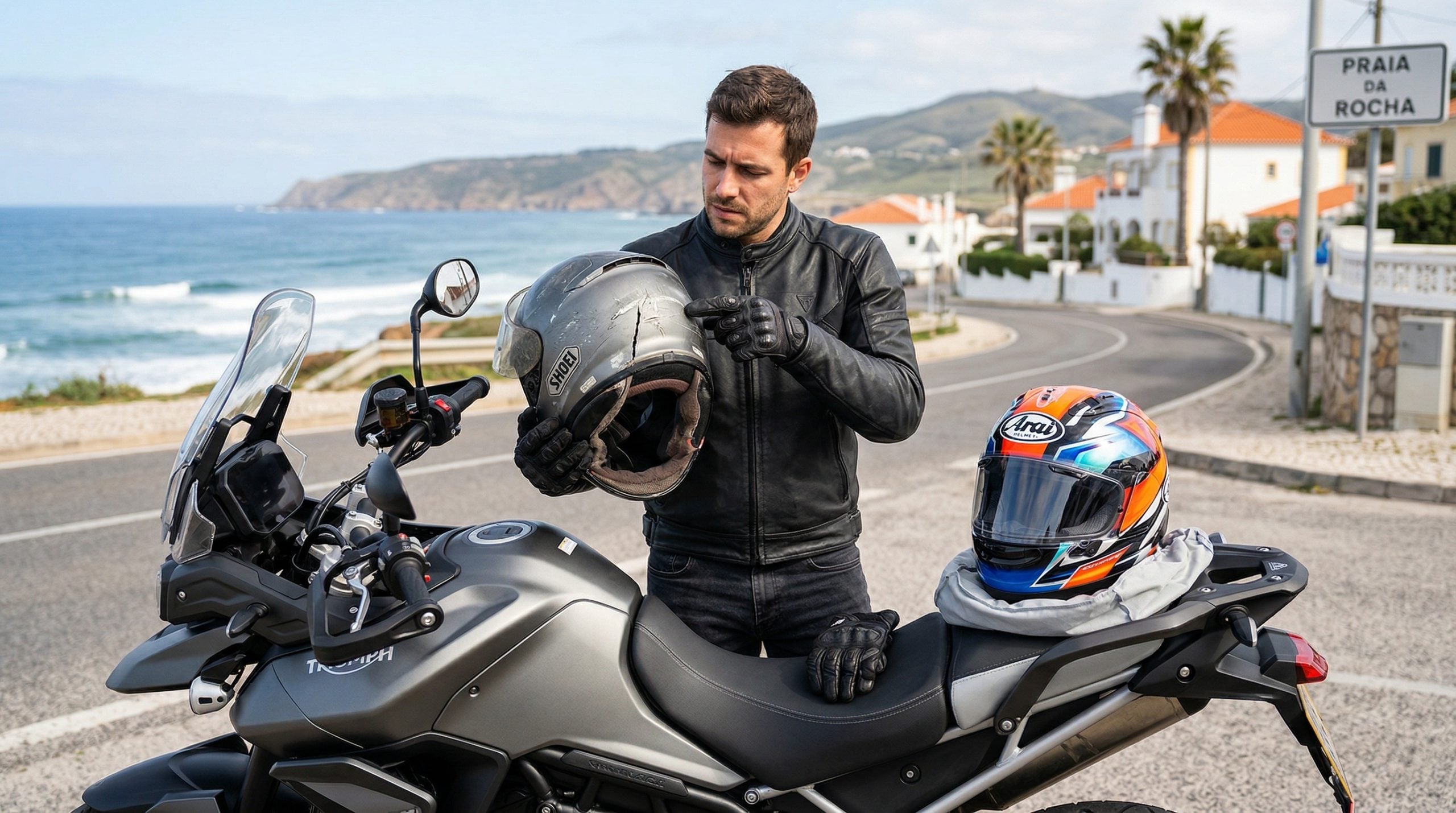
Riding a motorcycle in Portugal is a truly unique experience. Whether navigating the vibrant traffic and historic hills of Lisbon, feeling the salty breeze along the Guincho coast, or exploring the magical, winding curves of the Sintra Mountains, the sense of freedom is unmatched. However, that same freedom exposes the rider to unique vulnerabilities. On a motorcycle, there is no cabin, no programmed crumple zones in the bodywork, and no front or side airbags. Your primary—and often only—shield against severe injury is your protective gear.
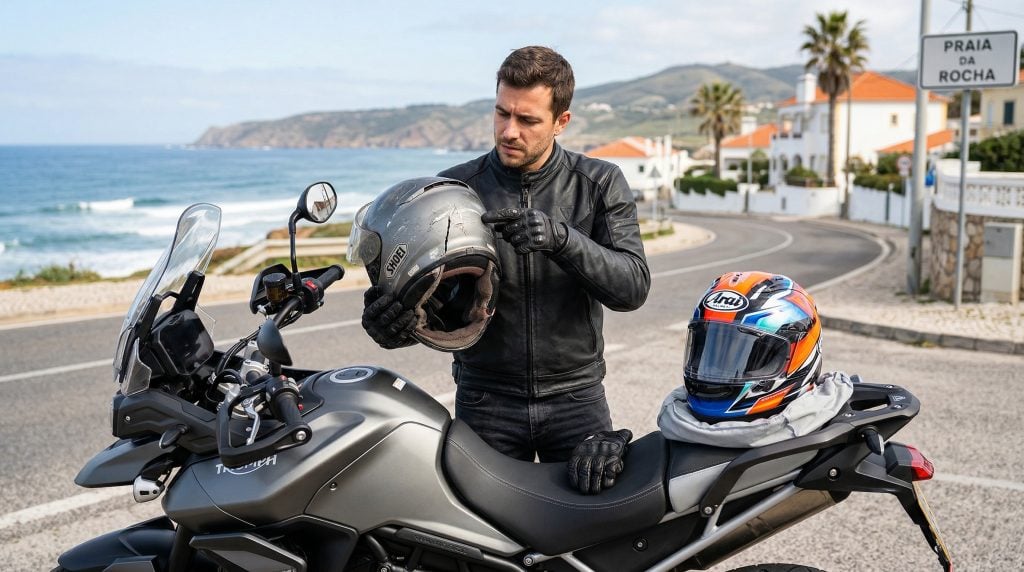
At the top of that gear list sits the helmet. Many motorcyclists, from beginners to seasoned veterans, spend hundreds or even thousands of euros to acquire a top-of-the-line helmet, drawn by the design, aerodynamics, or the graphics of their favorite MotoGP riders. The problem arises when they assume that, because they paid a premium price, the helmet will last a lifetime. This is one of the most dangerous fallacies in the motorcycling world.
A motorcycle helmet is not a diamond; it is not forever. It is a piece of equipment that undergoes constant active and passive wear and tear. It has a biological and chemical expiration date. Knowing exactly when to replace your motorcycle helmet is a vital skill that can dictate the difference between dusting yourself off after a fall or facing tragic consequences.
In this extensive guide prepared by the RENT.MOTO.pt team, we will dive deep into the science of helmet safety, analyze the latest regulations, identify invisible signs of degradation, and provide essential tips, whether you are a motorcycle owner or a tourist looking for the best motorcycle rental experience in Lisbon.
1. The Science and Anatomy of a Motorcycle Helmet
To understand why your helmet has an “expiration date,” it is imperative to dissect its anatomy. A modern helmet is not a simple plastic bucket filled with foam; it is a highly sophisticated piece of engineering designed to manage force and kinetic energy.
1.1. The Outer Shell
This is the first line of defense. It can be manufactured from different materials: thermoplastic resin (polycarbonate), fiberglass, carbon fiber, or Kevlar blends.
- Its function: To prevent the penetration of sharp objects (like rocks, footpegs, or vehicle edges) and to disperse the initial energy of the impact over the widest possible surface area.
- The wear and tear: Polycarbonate, in particular, is sensitive to ultraviolet (UV) radiation. Years of sun exposure degrade the chemical bonds of the plastic, making it brittle.
1.2. The Impact Absorption Liner (EPS)
Expanded Polystyrene (EPS) is, without a doubt, the most important part of the helmet. This is a thick layer of material that resembles styrofoam but is highly calibrated.
- Its function: The EPS is designed to crush and deform in a controlled manner during an impact. By crushing, it slows down the deceleration of the skull. If the head stopped instantly, the brain would violently smash against the walls of the skull. EPS extends the stopping time by critical milliseconds, reducing the transfer of lethal G-forces.
- The wear and tear: Over time, the microscopic EPS beads dry out, shrink, and harden. A hardened EPS does not deform in an impact; instead, it transmits the force directly to your head.
1.3. The Comfort and Fit Liner
The soft fabric and memory foam part that is in contact with your skin.
- Its function: To ensure the helmet fits the shape of your head perfectly, without gaps, while also absorbing perspiration and reducing wind noise.
- The wear and tear: The foam sags with continuous compression. Sweat (which is acidic) and bacteria corrode the fabrics, causing dangerous looseness.
1.4. The Retention System
Comprising the chinstrap and the buckle (which can be a double D-ring or a quick micrometric fastener). Its sole function is to ensure the helmet is not ripped off your head in a sliding or tumbling scenario.
The Snell Memorial Foundation, one of the world’s most highly regarded independent entities for helmet testing, dedicates rigorous studies to how each of these four components ages and fails under prolonged stress.
2. The Golden Rule: 5 Years of Use
If you ask any industry expert, the most standardized answer regarding helmet longevity is the rule of 5 years of use or 7 years after the manufacturing date. But where do these numbers come from?
2.1. Manufacturing Date vs. Purchase Date
Many riders buy a heavily discounted helmet from an online store, without realizing that it had already been sitting on a warehouse shelf for four years. All homologated helmets have a label inside, under the fabric liner or stamped onto the shell itself, displaying the month and year of manufacture. The EPS begins to degrade the day it leaves the factory mold, albeit slowly. Therefore, a maximum limit of 7 years from production is the industry consensus.
2.2. Why only 5 years of active use?
From the moment you put the helmet on for the first time, an accelerated countdown begins due to environmental and chemical factors:
- Exposure to the Elements: The sun, rain, extreme cold, and heat slowly bake the outer shell.
- Human Chemistry: The human scalp produces natural oils. Sweat contains salt and acids. Many riders use hair gel, hairspray, sunscreen, and cosmetics. All these chemicals seep into the liner and interact daily with the EPS, accelerating its deterioration.
- Fuel Vapors: If you store your helmet in the garage next to the motorcycle’s exhaust pipe or above fuel cans, be aware that gasoline and thinner vapors attack and melt the molecular structure of EPS in the long term.
3. The “One Impact” Law
If the 5-year rule is the expiration limit by age, the one-impact rule is the immediate end of the equipment’s life.
The design of a modern helmet is what engineers call “sacrificial.” It was designed to give its life to save yours. During an accident, when your helmet hits the asphalt, the EPS at that specific point compresses irreversibly. The chemical bonds burst to absorb the kinetic energy.
Attention: EPS does not recover its shape or properties. If you hit the same spot on the helmet in a second accident, even if the fiberglass outer shell shows no obvious damage, the protective styrofoam underneath is no longer there. The transfer of force to your brain will be almost total. For this reason, any helmet involved in a crash, even at speeds of 30 km/h, must be destroyed (cut the retention straps to ensure no one else uses it) and thrown into recycling.
What if the helmet drops from the bike to the ground?
This is a classic question. You left the helmet resting on the motorcycle tank, and it rolled off and fell onto the asphalt. Is it ruined? Physics tells us that impact energy depends on mass. An empty helmet weighs about 1.5 kg (3.3 lbs). A drop from three feet with this weight generally does not have enough energy to compress the rigid EPS inside. According to experts and official documents from the Motorcycle Safety Foundation (MSF), a drop without a head inside usually only results in cosmetic damage (scratches and paint chips). However, if the helmet falls from a great height, or if it hits a sharp corner that visibly damages the fiberglass shell, the precautionary principle dictates it should be replaced.
4. Diagnosis: Vital Signs That Your Helmet Is Dying
Do not ignore premature warning signs. A helmet used every day by a courier will last much less time than a Sunday rider’s helmet. Regularly check your gear looking for the following symptoms:
- The “Roll-Off” Test (Looseness): Put the helmet on and fasten the strap correctly. Now, grab the back of the helmet and try to pull it forward and off your head. If the helmet can rotate to the point of almost coming off, the interior foams are totally crushed and worn out. A loose helmet can fly off your head before the main impact occurs.
- Crumbling EPS: Remove the washable interior liner. Look at the black “styrofoam” (the EPS). Use your pinky fingernail and scratch it lightly. If the material crumbles into powder or looks dried out and brittle, your protection level is zero.
- Frayed Straps or Loose Buckles: The chinstraps withstand immense tension. If the nylon webbing is fraying at the edges, or if the micrometric buckle no longer locks with a strong, metallic “click,” there is a severe risk of catastrophic failure during a fall.
- Defective Visor Mechanisms: If your visor no longer seals out wind and rain, or if the hinged mechanism is loose and makes the visor drop on its own, material fatigue has set in.
5. The New Safety Standards: ECE 22.05 vs. ECE 22.06
Another pressing reason to replace an old helmet is the brutal advancement of safety technology and European homologation laws.
For two decades, the ECE 22.05 standard, regulated by the UNECE (United Nations Economic Commission for Europe), was the gold standard. However, in 2024, the new and highly demanding ECE 22.06 standard became mandatory for all new helmets sold in Europe.
What changed?
- More Impact Points: The old standard tested the helmet at 6 fixed points. Manufacturers could specifically “reinforce” those points to pass the test. ECE 22.06 tests 18 different points, chosen randomly, including the chin bar of modular helmets.
- Low-Speed Impacts: It was discovered that very rigid helmets, designed to protect at 200 km/h, transferred too much force in urban traffic falls (at 30 km/h). The new standard requires superior protection at lower speeds.
- Rotational Tests: This is the major breakthrough. In a real accident, heads rarely hit dead on. They glance off surfaces, causing a violent rotation of the skull that tears brain tissue and blood vessels. The 22.06 standard requires the ability to mitigate rotational acceleration (often using innovative technologies like MIPS).
If your helmet is a four-year-old 22.05, replacing it today with a modern 22.06 is not a whim; it is a quantum leap in your personal safety. Additionally, British entities like the SHARP program (Safety Helmet Assessment and Rating Programme) continue to provide independent ratings up to 5 stars that help you choose the safest model on the market.
6. How to Extend Your Helmet’s Lifespan (Maintenance)
To ensure your gear safely reaches the five-year mark, daily care is crucial:
- Never use harsh chemicals: Do not clean the visor or shell with glass cleaner (it contains ammonia that destroys polycarbonate). Use only warm water and mild soap.
- Liner washing: Hand wash the interior liner with baby shampoo (which is extremely gentle) and let it air dry; never use a dryer or place it over a heater.
- Where to rest it: Never leave your helmet hanging on the motorcycle’s rearview mirror. The sharp shape of the mirror will irreversibly crush the EPS inside, creating an invisible “hole” in your protection.
7. The Tourism and Motorcycle Rental Perspective
The scenario changes slightly if you are a visitor arriving in Portugal. Many tourists, to avoid airline baggage fees, opt to leave their own helmet at home. This means you will be dependent on the equipment provided by the rental agency.
When searching for a motorcycle rental company, do not just focus on the daily price of the scooter or bike. The focus must also be on the safety standards of their accessory fleet.
A serious and professional rental service stands out by:
- Recent Helmet Fleets: The company must prove that it discards helmets before the end of their legal and safety validity.
- Absolute Hygiene: The equipment must be disinfected with antibacterial foams specific for motorcycle liners after every return, for obvious sanitary reasons.
- Variety of Sizes: A “one size fits all” helmet does not exist. The company must have sizes ranging from XS to XXL. A helmet that is too large in a crash will rotate and break your jaw or neck. You must ask for a size that fits snugly.
- Physical Integrity: Demand to check the helmet before riding off. Inspect the buckle and look at the EPS. If you see broken EPS or a visor that does not allow you to see clearly, immediately ask for a replacement.
Now that you know exactly when it’s time to replace your motorcycle helmet, the next important step is choosing a high-quality replacement. For practical advice on where to buy a reliable helmet — whether in physical stores in Portugal or trusted online shops — check out our complete guide: Where to Buy Motorcycle Helmets.
Investing in a proper helmet that meets the latest ECE 22.06 standards and fits your head perfectly is one of the best decisions you can make for your safety on the road.
Conclusion and Your Next Step
Your head is, unquestionably, the most valuable piece of equipment you carry on any trip. Knowing when and why to replace a motorcycle helmet is a demonstration of maturity and respect for your own life and your loved ones. Memorize the 5-year rule, watch out for material degradation, demand the latest ECE standards, and reject helmets with a dubious history.
If you are planning a dream trip on Portuguese roads and the safety component is a non-negotiable factor for you, you have come to the right place. When searching for the most prestigious motorcycle rental in the Lisbon region, demand partners who put your well-being at the top of their priorities.
At RENT.MOTO.pt, our commitment goes far beyond handing you the keys to a flawless motorcycle. We subject our fleet of protective gear to exhaustive evaluations. Our helmets are periodically renewed, rigorously sanitized through professional processes, and meet the highest and most recent European safety homologations. We guarantee you will have the right size, the perfect fit, and the peace of mind to enjoy every corner.