Via Verde Portugal: Paying Motorcycle Tolls and Classes
How to pay tolls in Portugal by motorcycle with Via Verde Portugal: Class 1, electronic tolls and solutions for visitors with a foreign vehicle.
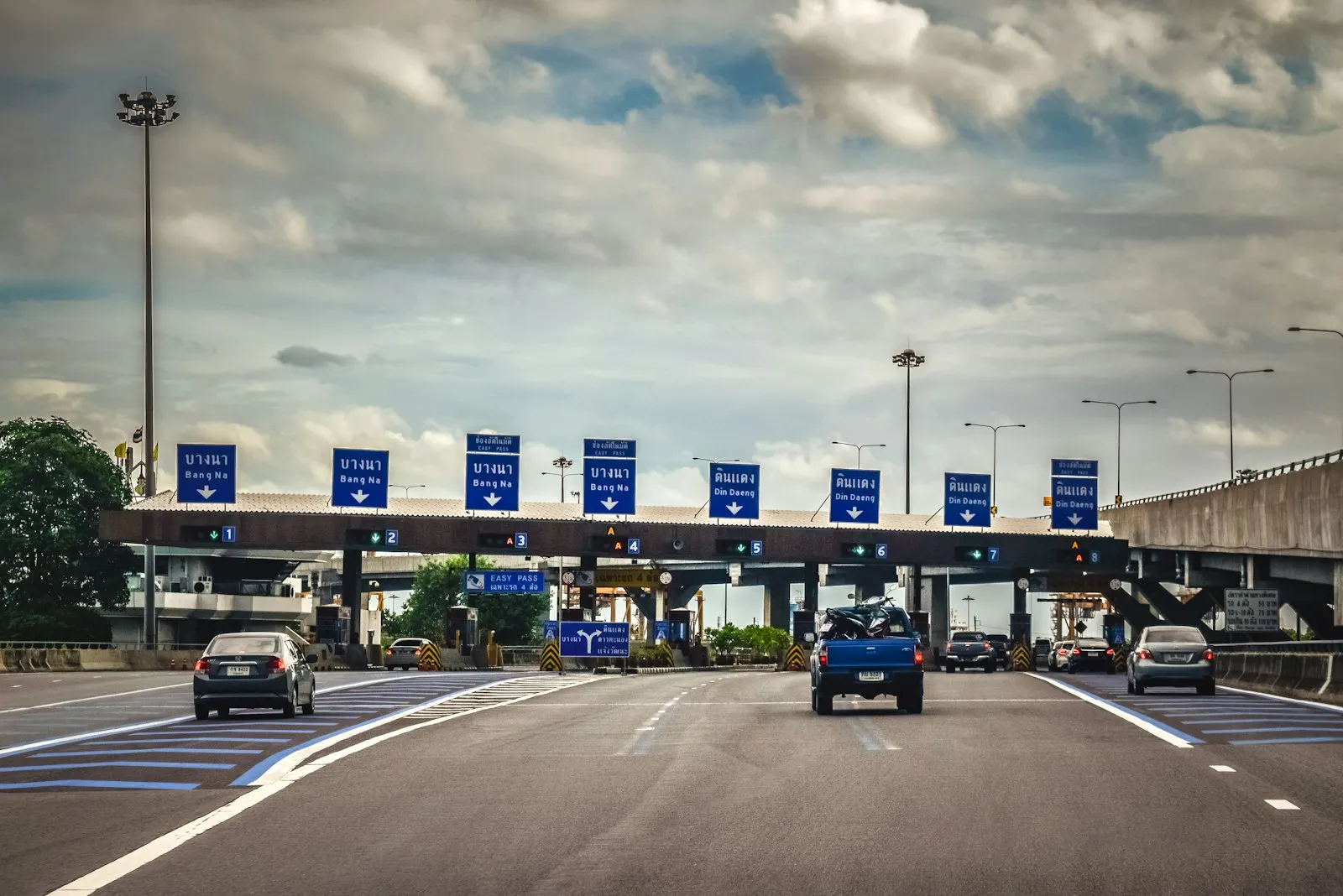
Anyone arriving in Portugal by motorcycle soon discovers that paying tolls is not just a matter of dropping coins into a barrier. Some motorways have toll booths, others only electronic gantries, there are two bridges in Lisbon, and several systems exist for riders without a Via Verde account. This guide to Via Verde Portugal explains how to pay tolls in Portugal on two wheels: the vehicle classes, Via Verde, electronic-only tolls and the solutions for visitors with a foreign vehicle. The facts come from official pages consulted in November 2026, and we do not include loose toll prices, because they change and the official simulator always gives the right figure.
Summary:
- Motorcycles pay Class 1, the same as vehicles under 1.10 m in height at the front axle.
- Riders who join Via Verde are treated as Class 5, and Via Verde advertises a 30% discount for motorcycles.
- Some motorways have no toll booths: the passage is recorded by gantries and you pay afterwards or with a transponder.
- For foreign vehicles there are four solutions: EasyToll, TollCard, TollService and Via Verde Visitantes.
- When renting at RENT.MOTO.PT, tolls during the rental period are the customer's responsibility and may be deducted from the deposit.
Where you pay tolls in Portugal
The official gov.pt guide on traffic rules and mobility sums up the picture well: tolls are paid on some motorways and on the two bridges linking Lisbon to the south bank of the Tagus. It is not the whole network. Most national roads, including famous motorcycle routes, have no tolls, and choosing between motorway and national road is one of the most important decisions of any day on a motorcycle.
Payment can be manual or electronic. It is worth understanding the difference before you set off, because the typical mistake of visitors is to reach a motorway without a booth and not know what to do.
Manual toll
On roads with a toll booth, the rider stops at a gantry with a barrier and pays an attendant or a terminal, in cash or by card. Riders with Via Verde use the dedicated lanes, with no barrier, where the transponder is read automatically. On a motorcycle, stopping at a booth takes discipline: left hand holding the handlebar, foot on the ground, wallet or card already out of your pocket before you arrive. Anyone who keeps their card at the bottom of a backpack ends up fumbling with zips while the queue grows behind.
Electronic-only toll
Some motorways have no toll booths. Vehicles are identified by automatic gantries along the road, and these roads are signposted as exclusively electronic toll. If you have a Via Verde transponder, you pass without stopping. If you do not, you need to settle the payment another way, and that is where the visitor solutions described below come in. Passing under an electronic gantry without any system is not a minor detail: the debt exists and has to be settled.
The two Lisbon bridges
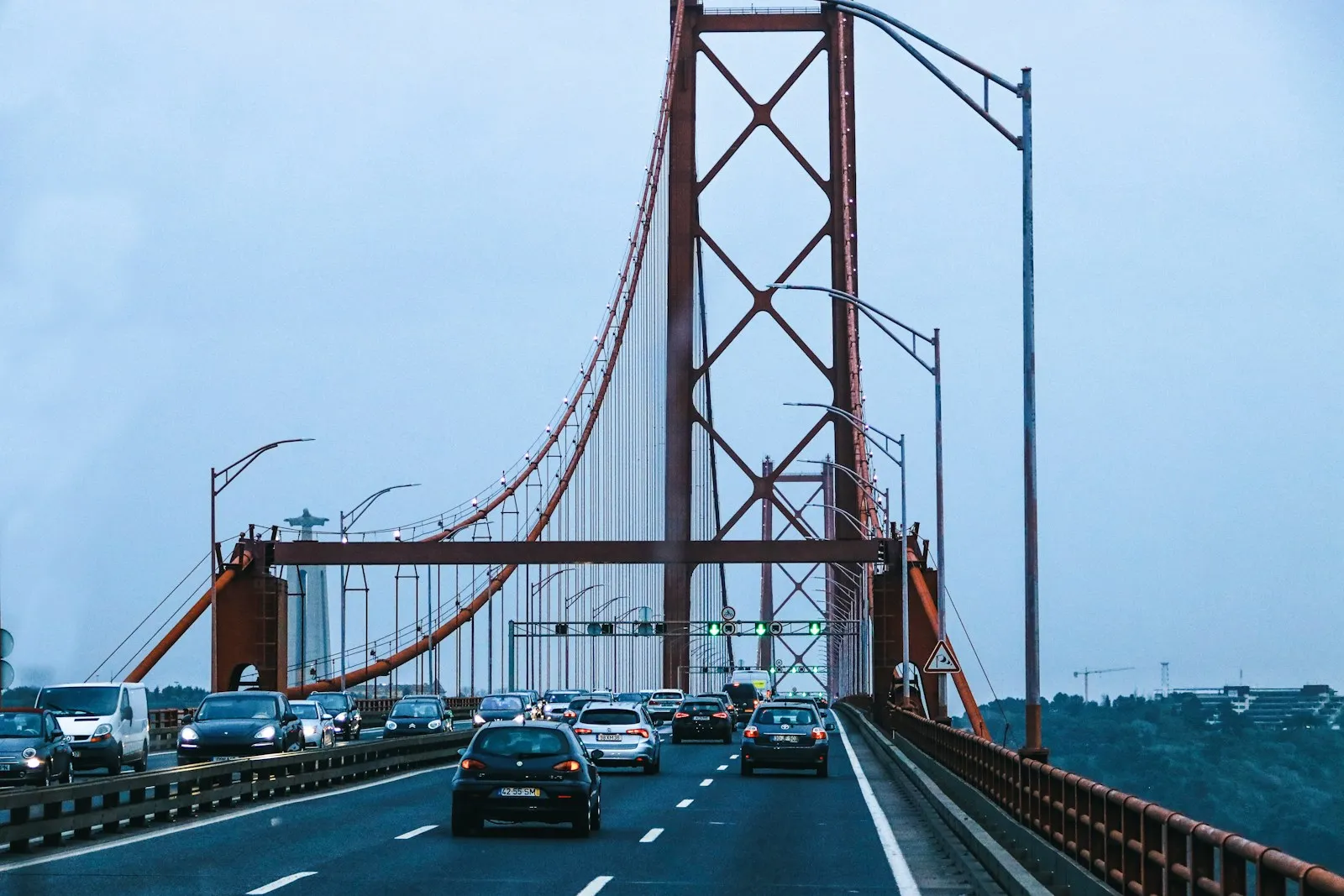
Both Tagus crossings in the Lisbon area are tolled, according to gov.pt. This matters if you rent a motorcycle on the south bank and want to cross into Lisbon, or if you make the return trip after a day in the capital. Before planning your route, check the official toll simulator of Infraestruturas de Portugal (the Portuguese road infrastructure authority), which calculates the cost of a route by vehicle class and shows the network map.
Vehicle classes: where the motorcycle fits
Portuguese tolls depend on the vehicle class, and the class depends on two criteria: the height measured vertically over the first axle and the number of axles. The Via Verde page on vehicle classes, which refers to Base XIV of Decree-Law no. 294/97, gives the following list.
| Class | Vehicles |
|---|---|
| Class 1 | Motorcycles and vehicles under 1.10 m in height |
| Class 2 | 2-axle vehicles with a height of 1.10 m or more |
| Class 3 | 3-axle vehicles with a height of 1.10 m or more |
| Class 4 | Vehicles with 4 or more axles and a height of 1.10 m or more |
| Class 5 | Only for motorcycles registered with Via Verde |
The point that causes most confusion is Class 5. gov.pt states that this class exists only for motorcycles registered with Via Verde, and the Via Verde page explains that, on joining, the motorcycle is considered Class 5 with a special discount. In one version of the footnote the discount is 30%, with the exception of the Vasco da Gama Bridge. Since the page itself is not entirely consistent on this point, confirm the current figure directly with Via Verde before counting on it.
In practice, a motorcycle without Via Verde pays the Class 1 rate, the same as a low-height passenger car. The advantage of being on a motorcycle is therefore not in the base rate, but in the freedom to choose national roads and the ease of stopping wherever you like.
Via Verde on a motorcycle
The Via Verde transponder works on any toll concession in the country, as long as it is linked to a debit card and a registered licence plate. At the entrance of a motorway with toll booths it records the place, date and time; at the exit, the reader reads that data, the transponder and the class, and shows the amount charged to the Via Verde account.
On a motorcycle there is no windscreen to stick the transponder on. Via Verde states that, on motorcycles, the transponder goes in a dedicated pouch supplied with the equipment. If you pass under a gantry and see a yellow light, Via Verde recommends checking the Message Centre of your online account, confirming that the licence plate is correctly linked to the transponder and that it is properly positioned, in the pouch, in the case of motorcycles.
Anyone thinking of joining Via Verde for a short trip should bear in mind that joining requires a contract, an account and a card. For visitors, the system created a different solution, which we look at next. In any case, always follow the speed limits on Via Verde lanes, as the page itself reminds you.
Visitors with a foreign vehicle: four solutions
gov.pt describes four ways to pay tolls with a foreign-registered vehicle. The values below are those given on that page in November 2026, so always check the operators' websites before you travel.
EasyToll
It links a bank card (Mastercard, Visa or Maestro) to the vehicle's licence plate. Registration takes place at dedicated points: at the Viana do Castelo service area (A28), 3.5 km from the Chaves/Verín border (A24), at Alto de Leomil, in Vilar Formoso (A25), and next to the Castro Marim/Ayamonte border (A22). It is a solution designed mainly for those entering Portugal overland from Spain.
TollCard
A prepaid card activated by SMS, with a fixed value and valid for one year. It can be paid for in cash or by bank card, and the balance can be checked online. It is sold online, in CTT (the Portuguese post office) shops and at service areas on the A23, A22, A25, A28, A2, A6, A3 and A7 motorways.
TollService
A prepaid card with two options. The first gives unlimited use for 3 days for 20 euros, plus 0.74 euros for registration, and is only valid for classes 1 and 2. The second is a card loaded for a specific route, for example from Spain to Porto Airport via the A28 or A41, or from Spain to Faro Airport via the A22, one way or round trip. It is sold at selected Cepsa service areas, at Porto Airport, at CTT and online.
Via Verde Visitantes
A temporary electronic device. Tolls are charged by direct debit to a bank account, with no additional administrative fees, and it works on all motorways, traditional or electronic-only. It can be bought at Via Verde shops or online. For anyone driving several motorways on a long route, it is the one that depends least on fixed registration points.
CTT has a dedicated page for toll products for foreign licence plates, where you will also find the points of sale. If the trip is only a few days long and has just one or two tolled sections, compare the cost of each solution with that of the route on national roads: often the time difference is small and the scenery is far better.
Planning your route before you set off
The toll simulator and motorway map from Infraestruturas de Portugal is the most useful tool for motorcycle riders. You choose the origin, the destination and the class, and the result shows the cost and the tolled sections. Do this exercise at home and then repeat it with the alternative via national roads. Two or three comparisons are enough to see that there are days when the motorway is worth it and others when it is just noise.
For those who want to explore the country at a relaxed pace, national roads are the motorcycle's natural territory. The Estrada Nacional 2, from Chaves to Faro, is the best-known example, but there are many others. On the other hand, to cover the distance from Lisbon to a faraway region in a single day, the motorway saves hours of fatigue, especially in wind and heat.
Also check the Infraestruturas de Portugal traffic alerts before you leave, to learn about roadworks and closures. A motorcycle copes well with detours, but it is no fun discovering a closed section only at the access ramp.
Good habits for passing through tolls by motorcycle
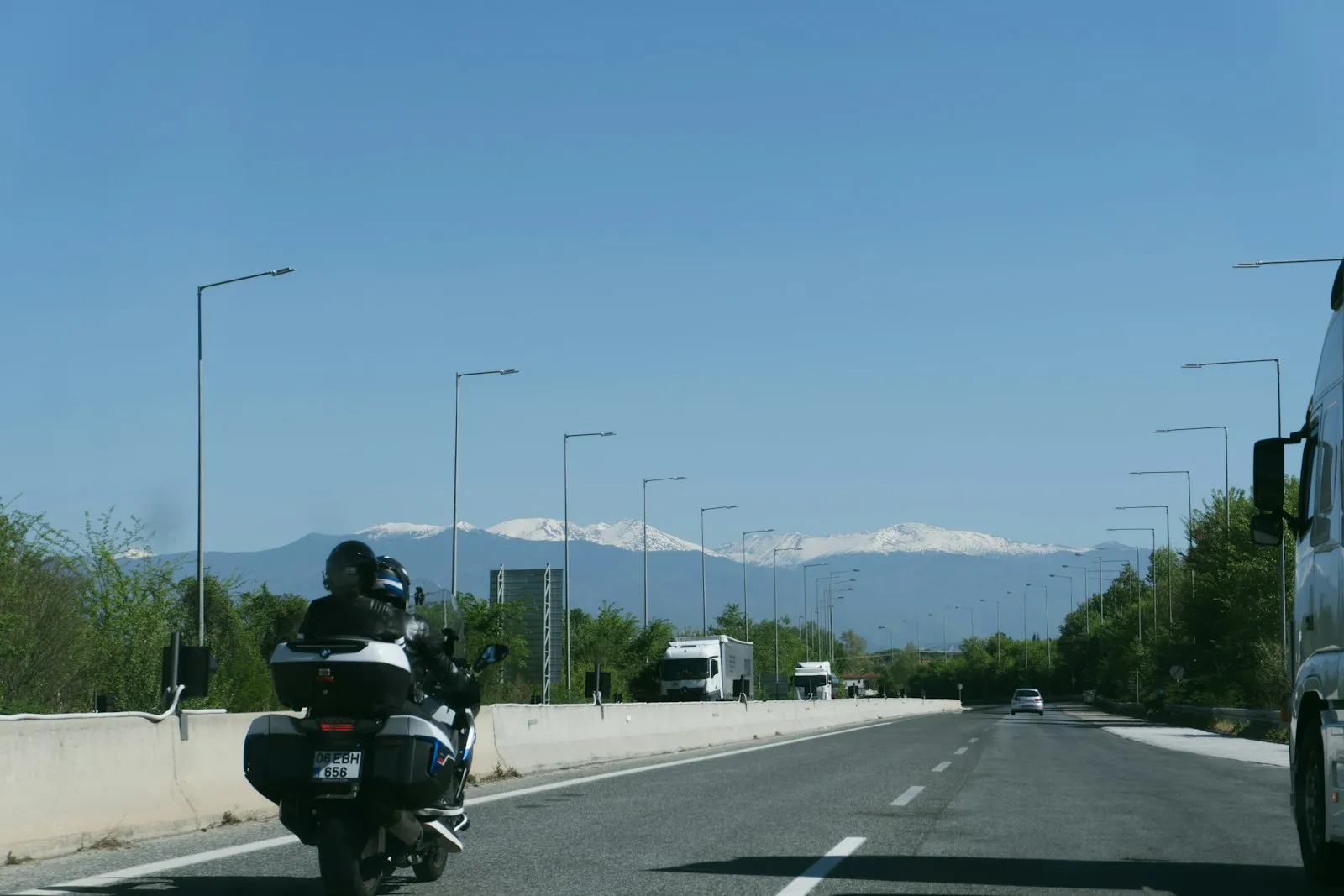
There are a number of simple habits that make passing through a toll much more comfortable on two wheels.
- Have your means of payment ready before the booth: card or coins in an outside jacket pocket, easy to reach with gloves on.
- Slow down early and keep your distance from the vehicle ahead, because the surface near the booths can have oil stains and braking marks.
- Choose the right lane. If you do not have a transponder, do not enter a Via Verde lane, however much shorter the queue looks.
- At electronic-only tolls, do not stop or slow down abruptly: the passage is recorded while moving.
- Keep proof of payment and references until the end of the trip.
- On a rainy day, avoid hard braking on the painted strips at the entrance to the booths.
If you are travelling in a group, agree on a meeting point after the toll. It is very common for the group to scatter at the exit, because each person uses a different lane.
Renting at RENT.MOTO.PT: tolls and deposit
If you rent a motorcycle in Portugal, there is one rule to remember. Under the RENT.MOTO.PT Terms and Conditions, tolls during the rental are the customer's responsibility and may be deducted from the deposit. Since the deposit is a pre-authorisation on your card, how it works and how the amount is released is explained in the article on the motorcycle rental deposit.
For a route with motorway sections where you will pay Via Verde Portugal tolls by motorcycle, trail bikes and big adventure bikes are the natural choice, and for the city and the south bank a scooter for Via Verde Portugal tolls without complications handles most short routes. The price and booking for each model are always on its page.
Frequently asked questions about tolls
Which toll class does a motorcycle pay?
Motorcycles pay Class 1. Riders who have joined Via Verde are treated as Class 5, with a discount that Via Verde advertises as 30%, and which, according to a note on the page itself, does not apply to the Vasco da Gama Bridge. Confirm the current figure with Via Verde.
What is an electronic-only toll?
It is a motorway without toll booths, where automatic gantries identify the vehicle. These roads are signposted as exclusively electronic toll, and payment is made with a transponder or through one of the available solutions.
How do visitors with a foreign vehicle pay?
gov.pt lists four options: EasyToll, TollCard, TollService and Via Verde Visitantes. Each has its own points of sale and conditions, so compare them before you leave.
Do all roads in Portugal have tolls?
No. Only some motorways and the two bridges between Lisbon and the south bank. Many national roads have no tolls and are excellent for motorcycling, but they take more time.
What if I rent a motorcycle at RENT.MOTO.PT?
Tolls during the rental period are the customer's responsibility and may be deducted from the deposit, as the Terms and Conditions state. If you want to reduce the cost, the Infraestruturas de Portugal simulator helps you compare the motorway route with the national roads, and the official traffic alerts show closures and roadworks before you set off.
Ready to ride in Lisbon?
Book your motorcycle or scooter in a few minutes, with delivery across Lisbon.
View the fleetSources
- 1official gov.pt guide on traffic rules and mobilityhttps://www.gov.pt/guias/regras-de-transito-e-mobilidade-em-portugal
- 2official toll simulator of Infraestruturas de Portugalhttps://portagens.infraestruturasdeportugal.pt/
- 3Via Verde page on vehicle classeshttps://www.viaverde.pt/particulares/ferramentas/classe-veiculos
- 4Via Verde transponderhttps://www.viaverde.pt/particulares/ViaVerde/Servi%C3%A7os/Autoestradas
- 5dedicated page for toll products for foreign licence plateshttps://www.ctt.pt/particulares/pagamentos/pagar-servicos-portagens/portagens/matriculas-estrangeiras/
Motorcycle and scooter rental in Lisbon, Portugal.
All articles by the teamYou may also like
Lisbon to Seville by Motorbike: 3 Routes and a 4-Day Itinerary
Lisbon to Seville on a rental motorbike: three routes through the Alentejo, distances, stops, a 4-day itinerary and the Spain border rule.
Read more →
Elvas Portugal by Motorcycle: UNESCO Walls and 2 Days
Elvas Portugal by motorcycle from Lisbon: 200 km, World Heritage walls, Forte da Graça, Amoreira Aqueduct, best bike and a 2-day itinerary.
Read more →
Marvão, Portugal by Motorbike: 2-Day Trip from Lisbon
Marvão, Portugal and Castelo de Vide by motorbike from Lisbon: castle on the rock, Serra de São Mamede, 2 days, distances, best bike and tips.
Read more →