
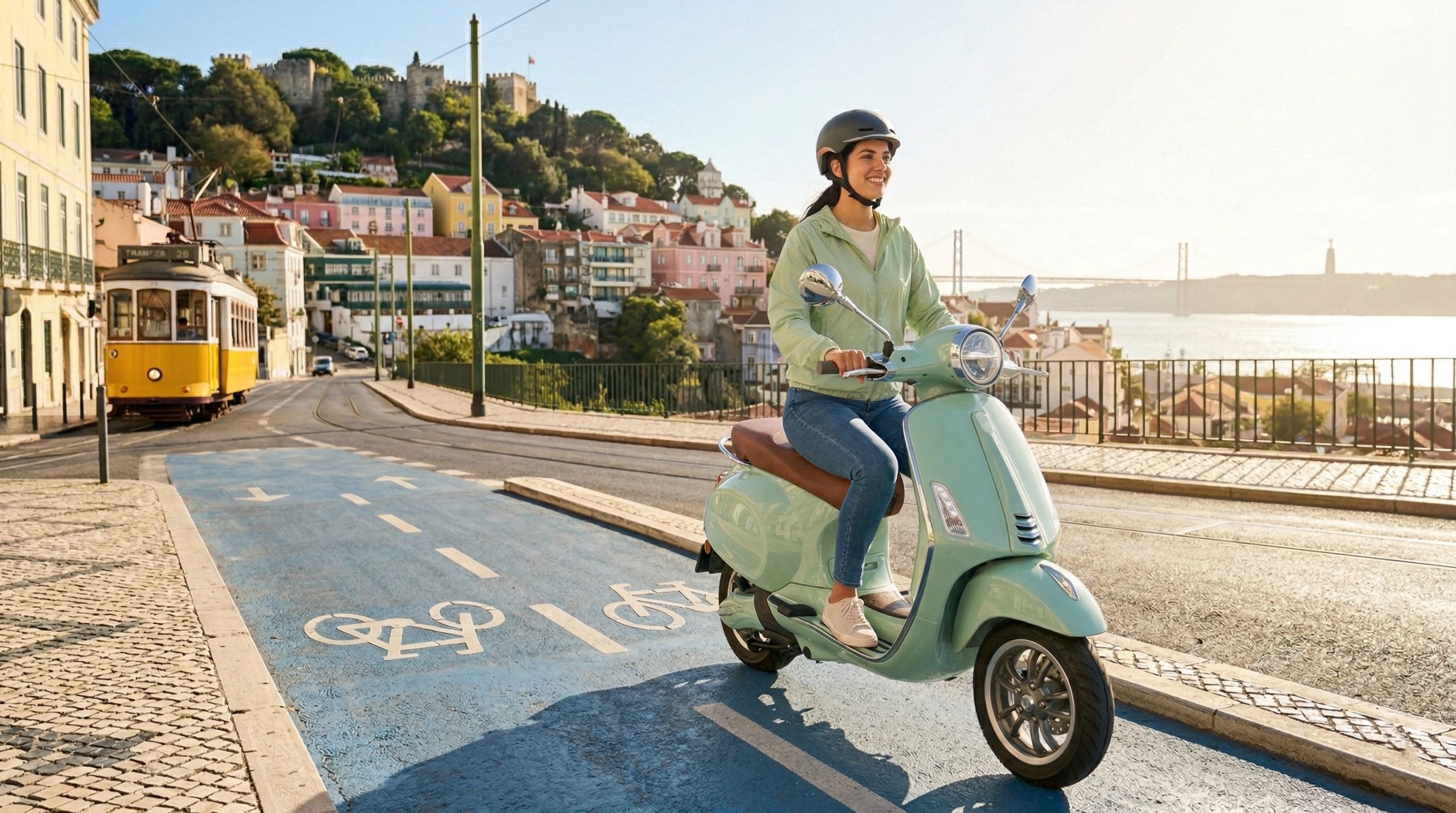
The urban landscape in Portugal and across Europe is undergoing a profound and irreversible transformation. From the historic hills of Lisbon to the riverside avenues of Porto, and down along the sun-drenched coastal roads of the Algarve, the way we move is changing at an astonishing pace. At the very core of this monumental mobility revolution lies a singular, agile, and eco-friendly vehicle: the electric scooter, specifically the models and variants that do not require the possession of a driver’s license. This article aims to be the most exhaustive, detailed, and comprehensive guide ever written on this subject, meticulously deconstructing all the legal, technical, environmental, economic, and social aspects of this new form of transportation that is fundamentally redefining life in both large metropolises and small towns.
1. The Evolution of Urban Transport and the Need for Change
Historically, human settlements and cities were constructed around pedestrians and horse-drawn carriages. With the dramatic arrival of the industrial revolution and the subsequent advent of the internal combustion engine in the 20th century, urban planning shifted drastically to accommodate the automobile. Streets were systematically widened, sidewalks were dangerously shrunk, and thick asphalt covered the old, charming cobblestone paths. However, in the 21st century, this car-centric model has unequivocally proven to be unsustainable. The chronic, gridlocked traffic congestion, the severely toxic air pollution that aggressively damages public health, the deafening noise of diesel engines, and the perpetual, frustrating lack of parking space have collectively created a genuine mobility crisis in metropolitan areas around the globe.
It is precisely within this frustrating scenario of automotive saturation that micromobility emerges not merely as a fun alternative, but as an absolutely urgent necessity. Micromobility refers to very lightweight vehicles, typically designed to carry a single passenger, that operate at moderate and safe speeds. Within this rapidly expanding category, the electric scooter (often materialized in the popular form of robust electric kick-scooters or electric bicycles with a scooter-like design, commonly known as pedelecs) has brilliantly stood out as the absolute perfect solution for the notoriously difficult “first and last mile” problem. The extraordinary ability to operate one of these vehicles without facing the heavy bureaucracy, the lengthy time commitment, and the substantial financial cost associated with obtaining a traditional driver’s license has effectively opened the golden doors of independent mobility to millions of citizens, ranging from young university students to active senior professionals.
2. What Exactly Defines a License-Free Electric Scooter? The Technical and Legal Perspective
To fully comprehend this widespread phenomenon, it is absolutely imperative to define exactly what constitutes a “scooter” that can be legally operated without a driver’s license in Portugal. Frequently, the term “scooter” alone generates significant confusion, as it can refer either to heavy mopeds (like the traditional, classic Vespas) or to lightweight, motorized kick-scooters. According to strict Portuguese law, a traditional moped (even a purely electric one) that is fully capable of reaching speeds up to 45 km/h legally requires, at the very least, an AM category driver’s license to be operated on public roads.
However, the highly sought-after exemption from holding a driver’s license specifically applies to vehicles strictly classified by the law as “velocipedes equipped with an auxiliary motor”. For an electric scooter, a kick-scooter, or an e-bike to successfully fall under this highly advantageous and legally favorable category, it must rigorously comply with very specific, well-defined technical specifications set by the authorities:
- Maximum Continuous Power Output: The electric motor’s power simply cannot exceed 250 Watts (0.25 kW) under any normal continuous operating circumstances.
- Maximum Motor-Assisted Speed: The electrical assistance provided by the motor must be automatically and completely cut off the moment the vehicle reaches a speed of 25 km/h.
- Absence of an Independent Throttle (in specific formats): In the particular case of electric bicycles that feature a scooter-like frame, the electric motor must only engage and provide power when the user is actively pedaling (this is known as the pedelec system). Conversely, in the case of electric kick-scooters (trotinetes), a manual throttle mechanism is completely legally permitted, but the strict 25 km/h speed limit firmly remains a mandatory and heavily enforced requirement.
These detailed technical limitations are certainly not arbitrary or random; they were carefully and deliberately established by safety engineers and lawmakers to guarantee that the kinetic energy generated by the vehicle in the unfortunate event of a collision is strictly maintained at a highly manageable level, thereby dramatically minimizing the devastating risk of serious, life-altering injuries for both the rider operating the vehicle and the innocent pedestrians sharing the public space. It is precisely this delicate and essential harmonization between daily utility and public safety that empowers the Instituto da Mobilidade e dos Transportes (IMT) and other relevant Portuguese authorities to officially classify these light vehicles in a manner remarkably similar to traditional pedal bicycles, thereby wonderfully exempting them from the burdensome requirements of official license plate registration, mandatory liability insurance (although insurance experts highly and universally recommend it), and the necessity of possessing a valid driver’s license.
3. The Legal Framework in Portugal and Crucial European Harmonization
Traffic legislation and road safety laws act as the essential backbone that securely supports the safe and orderly integration of these novel vehicles into our busy, complex cities. The Portuguese Highway Code (Código da Estrada) has been recently updated and carefully adapted to properly handle the massive, unprecedented influx of lightweight electric trotinetes and scooters. Legally equating these specific vehicles to traditional bicycles fundamentally means that their users possess very specific legal rights and equally important legal duties that must be thoroughly learned, deeply understood, and strictly respected down to the smallest detail by everyone using the public roads.
First and foremost, the circulation of these vehicles must be done, preferably and ideally, within designated cycle paths (ciclovias – special dedicated lanes created exclusively for velocipedes) whenever these paths actually exist and are in safe, usable condition. In the complete absence of such dedicated cycle paths, the users of these license-free electric scooters must carefully ride on the main roadway (carriageway), positioning themselves as far to the right side of the road as safely possible, and they must strictly obey every single traffic sign, traffic light, pedestrian crosswalk, and applicable speed limit just like any other motor vehicle driver. It is strictly, explicitly, and categorically prohibited for these motorized vehicles to be ridden on sidewalks that are legally designated for pedestrian use only. This specific rule is currently one of the most heavily monitored and actively enforced regulations by police authorities in major Portuguese cities, primarily due to the severe and imminent risk of accidentally hitting highly vulnerable pedestrians, such as elderly citizens, pregnant women, and young children.
The European Commission has been proactively and continuously promoting guidelines aimed at the harmonisation of micromobility rules across all Member States, with the ultimate grand objective of creating a much more cohesive single market and establishing highly predictable traffic rules for all citizens traveling within the European Union. Although minor, highly localized variations certainly exist from country to country, the strict rule dictating a 250W power limit and a 25 km/h maximum speed is widely considered the absolute European gold standard. Furthermore, while the use of a protective helmet is not strictly mandatory by national law for adults (over 18) riding trotinetes or electric bicycles in mainland Portugal, it is exhaustively, passionately, and universally recommended by all major road safety organizations, medical professionals, and traffic authorities. The convenient exemption from holding a driver’s license certainly does not equate to an exemption from civil responsibility; in the unfortunate event of an at-fault accident, the user can and will be held fully legally and financially liable for any material damages and bodily injuries tragically caused to third parties.
4. The Deep Environmental Impact: Breathing Deeply in a Much Greener Future
The single most deeply convincing and globally relevant argument supporting the massive, widespread adoption of lightweight electric scooters is their overwhelmingly positive, truly transformative environmental impact, especially when directly compared to highly polluting internal combustion engine vehicles. The global climate transition is undisputedly the greatest and most urgent existential challenge of our current century. Urban metropolitan areas are unfortunately responsible for a massively disproportionate percentage of the world’s total global greenhouse gas emissions.
When we consciously make the choice to operate a license-free electric scooter, we are actively and significantly helping to remove noisy, fossil-fuel-burning automobiles from our crowded circulation networks. These remarkably small vehicles boast an operational carbon footprint that is practically zero. They absolutely do not emit any harmful carbon dioxide (CO2), dangerous nitrogen oxides (NOx), or deadly fine particulate matter (PM2.5 and PM10) directly from a tailpipe during their daily use on the streets. The European Environment Agency (EEA) has published countless, deeply concerning scientific reports urgently warning governments about the devastating, widespread consequences of notoriously poor air quality in densely populated European cities, directly linking atmospheric air pollution to a horrific rise in severe respiratory problems, debilitating cardiovascular diseases, and countless tragic premature deaths. Successfully substituting a short, 5-kilometer daily car journey with a quick, breezy trip on an electric trotinete or lightweight scooter not only wonderfully alleviates frustrating traffic congestion, but it also contributes directly, measurably, and immediately to the essential cleaning of the air that the entire local community breathes every single day.
Beyond the critical issue of atmospheric pollution, one must also carefully consider the severe issue of noise pollution. The constant, aggressive roar of heavy traffic is a massive source of chronic psychological stress for city dwellers, negatively affecting the quality of deep sleep and overall mental well-being. The small 250W electric motors utilized in these vehicles are almost entirely silent, beautifully transforming the harsh acoustic landscape of our cities and finally returning much-needed tranquility and peace to quiet residential neighborhoods. Naturally, the long-term, true sustainability of these modern vehicles also heavily depends on the complex, global processes determining exactly how their lithium-ion batteries are initially mined and produced, how they are maintained during their life, and, crucially, how efficiently they are eventually recycled at the very end of their useful life cycle. However, significant, rapidly accelerating technological advancements in the European circular economy and state-of-the-art battery recycling processes are thankfully making the entire life cycle of these amazing vehicles increasingly eco-friendly and deeply sustainable.
5. The Economic Analysis: The Incredible Rise of the Sharing Economy and Scooter Rentals
From a strictly financial and economic perspective, adopting electric micromobility offers truly substantial, life-changing monetary savings that simply cannot be ignored by anyone looking to optimize their personal budget. Owning a traditional car in Portugal fundamentally involves dealing with a massive, never-ending myriad of hidden, recurring, and painful costs: the exorbitant initial purchase price, the mandatory annual road tax (Impuesto Único de Circulação – IUC), the legally required civil liability insurance premiums and expensive comprehensive collision coverage, mandatory periodic vehicle inspections, high maintenance costs (including frequent oil changes, expensive brake pad replacements, timing belts), volatile and heavily taxed fuel prices at the pump, and the increasingly outrageous costs associated with urban parking spaces and highway tolls.
In sharp, wonderful contrast, purchasing a personal electric scooter or a 250W trotinete requires a vastly smaller initial financial investment, and the incredibly low costs associated with charging the battery overnight at your home using standard electrical outlets are almost entirely negligible on your monthly household electricity bill. However, even the relatively low cost of purchasing one of these fantastic lightweight vehicles might not actually be the most ideal solution for absolutely everyone. This is especially true for individuals who do not have safe, secure, and covered storage space at their home or their workplace, or for smart consumers who are actively seeking to completely avoid the inevitable long-term depreciation of the vehicle’s value and the eventually costly maintenance of replacing the lithium battery in a few years.
This is precisely the exact moment where the genuinely transformative power of the modern sharing economy brilliantly steps into the spotlight. The innovative practice of scooter rental (the local Portuguese term deeply embedded in the culture for scooter rentals) has completely, utterly revolutionized how people access and utilize these vehicles daily. Through incredibly intuitive, elegantly designed smartphone applications, tech-savvy users can seamlessly locate via GPS, instantly unlock via Bluetooth, and securely pay for a nearby scooter, ultimately paying only for the exact, precise amount of time they actually spend riding it. The highly efficient business model behind the scooter rental miraculously completely eliminates all the frustrating fixed costs traditionally associated with vehicle ownership. The end-user never once has to worry about the annoying wear and tear on the rubber tires, sudden complex electronic failures, the rapid financial devaluation of the specific vehicle model, or the ever-present stressful threat of urban theft. The large, professional operating companies bravely assume absolutely all the heavy logistical responsibility, deploying fleets of vans to collect and charge the depleted batteries during the quiet night hours, and strategically redistributing the massive fleet of shiny vehicles across the highest-demand zones in the city just in time for the morning rush hour. This brilliant, highly complex system beautifully democratizes urban mobility, finally allowing ordinary citizens from widely varying socioeconomic backgrounds to instantly access incredibly fast, wonderfully clean transportation with just a simple, quick tap on the glowing screen of their mobile phone.
6. The Booming Tourism Sector and Authentic Local Discovery
Portugal globally stands as one of the most highly coveted, critically acclaimed, and heavily awarded tourist destinations in the entire world, universally beloved and renowned for its absolutely breathtaking historic architecture, its deeply rich and fascinating history, and its truly sweeping, spectacular coastal landscapes. The massive tourism industry fundamentally plays a critically crucial, load-bearing role in generating the country’s Gross Domestic Product (GDP). Naturally, the way modern, sophisticated tourists choose to actively explore the beautiful Portuguese territory has evolved far, far beyond simply piling into large, crowded, slow-moving tour buses or waiting in long lines for expensive traditional taxi cabs. The contemporary, savvy traveler intensely seeks complete personal autonomy, deep cultural immersion, and the unparalleled, joyous flexibility to freely discover the absolute best-kept, hidden secrets of these ancient cities, bravely venturing far off the heavily beaten, common tourist paths.
For international visitors and newly arrived expats alike, the dynamic local vehicle rental market offers an incredibly wide, dizzying multiplicity of exciting options. While some highly enthusiastic, adrenaline-seeking two-wheel aficionados actively search for a classic, heavy-duty motorcycle rental service specifically designed to rent large displacement, high-powered motorbikes with the grand, ambitious goal of touring the famous, mythic National Road 2 (Estrada Nacional 2) from the very top of the country to the bottom, the overwhelming, vast majority of casual visitors who choose to stay comfortably lodged within the dense, bustling urban centers strongly prefer the incredible agility, the wonderful simplicity, and the total, blissful absence of annoying legal bureaucracy offered by lightweight scooters that brilliantly do not require a driver’s license.
Armed with a delightfully nimble electric trotinete or a license-exempt lightweight electric scooter, a curious tourist can incredibly easily, almost effortlessly navigate through the intricate, stunningly beautiful grid of streets in the historic Baixa Pombalina district in downtown Lisbon. They can smoothly, quietly glide along the picturesque, romantic banks of the Douro River in Porto, tasting the breeze, or they can agilely commute back and forth between the various spectacular, golden sandy beaches of Vilamoura, Albufeira, or Lagos down in the sunny Algarve region. They achieve all of this magnificent exploration entirely without the immense, suffocating stress of desperately trying to find a sufficiently large parking space for a bulky rental car, or suffering the massive headache of attempting to decipher the notoriously complex, highly confusing paid parking zones and street signs present in different Portuguese urban areas. It represents, without a doubt, a truly perfect, harmonious symbiosis between ultimate tourist convenience and deep, profound respect for preserving the delicate local infrastructure.
7. Road Safety: A Crucial, Shared, and Joint Effort
With the undeniably exponential, remarkably rapid, and massive growth in the sheer number of micromobility vehicles currently operating on Portuguese roads, the critical issue of road safety has rightfully and necessarily become the absolute paramount concern of concerned lawmakers, emergency room medical professionals, forward-thinking urban planners, and everyday citizens. The complex, highly dynamic mixing of small trotinetes, bicycles, massive heavy-tonnage automobiles, giant public transport buses, and highly vulnerable pedestrians all sharing the exact same limited public thoroughfares inevitably creates dangerous friction and multiple points of potential, tragic conflict.
The World Health Organization (WHO) has powerfully, repeatedly, and passionately emphasized the absolute, vital necessity of intelligently designing modern cities in a way that actively, physically protects the most highly vulnerable road users, strongly advocating for applying the core, fundamental principles of the “Safe System Approach” to modern urban planning. What this complex theory actually means in practical, everyday terms is that the physical road infrastructure itself must be incredibly forgiving of inevitable human error. The highly accelerated, heavily funded expansion of extensive networks of dedicated cycle paths that are securely, physically segregated by heavy concrete barriers from fast-moving, heavy automobile traffic is, without a single shadow of a doubt, the absolute most critically determining factor in effectively reducing the alarming accident and fatality rates involving users of trotinetes and lightweight electric scooters.
However, despite these crucial infrastructural improvements, a massive, undeniably heavy burden of responsibility still falls squarely and equally upon the shoulders of the individual users themselves. Mastering the art of defensive driving is not a suggestion; it is an absolutely mandatory, life-saving survival skill on modern streets. Users of these license-exempt electric scooters must constantly, vigilantly anticipate the often erratic, highly unpredictable, and dangerous movements of much larger cars. They must be particularly hyper-aware of the incredibly dangerous “dooring” phenomenon (the sudden, blind opening of doors from parallel parked cars right into the cycle lane). They must skillfully and carefully avoid lingering in the massive, terrifying blind spots of heavy goods vehicles and long articulated city buses. They must learn to clearly, visibly, and well in advance signal all their turning intentions using distinct arm gestures. And, above all else, they must absolutely never, under any conceivable circumstance or excuse, attempt to operate these vehicles while under the highly dangerous, mind-altering influence of alcohol or illegal narcotic substances. Riding on wet asphalt, navigating the notoriously slippery traditional Portuguese cobblestone pavements (calçada portuguesa) when it rains, and carefully crossing the treacherous, slippery steel tram tracks found in historic cities like Lisbon and Porto absolutely demand deeply heightened attention, incredibly smooth, gentle steering maneuvers, and a very strictly moderated, low speed. Furthermore, the voluntary use of high-visibility, brightly colored equipment (such as reflective yellow or orange vests) when riding at night or during terribly poor weather conditions is critically important and demonstrably saves countless lives every single day.
8. Technological Innovations, Next-Gen Batteries, and the Road to the Future
The incredibly rapid, massive global adoption and the undeniable, enduring, phenomenal success of these license-free electric scooters and trotinetes would absolutely, categorically not have been possible without the truly incredible, groundbreaking technological revolutions that have recently occurred in the complex field of portable energy storage. The actual beating, vital heart of absolutely any modern electric vehicle is its highly complex, tightly packed battery pack. The ancient, incredibly heavy, environmentally toxic, and highly inefficient lead-acid batteries of the past have been thankfully, completely, and totally replaced by modern lithium-ion (Li-ion) technology. This incredible chemical technology is exponentially lighter, vastly more compact, significantly more powerful, and crucially capable of enduring many thousands of intense charge and discharge cycles over years of use with significantly less tragic degradation of its total energy capacity.
This remarkable technology is currently in a state of constant, dizzyingly rapid advancement. We are already clearly witnessing the exciting early developments and real-world implementations of much more highly efficient regenerative braking systems tightly integrated into these lightweight vehicles. These brilliant systems ingeniously capture the kinetic energy that is normally wasted as heat during the act of braking, or while the vehicle is simply coasting down a steep hill, and efficiently inject that precious electricity right back into the battery pack, thereby considerably, noticeably extending the actual, real-world driving range of the vehicle in a stop-and-go urban environment. Looking slightly further ahead onto the bright technological horizon, the world is eagerly anticipating the arrival of revolutionary solid-state batteries. These magnificent future batteries scientifically promise blisteringly fast, incredibly rapid recharge times, a vastly, monumentally superior energy density (which will eventually allow for even lighter vehicle designs or truly massive, unbelievable driving ranges), and an operational fire risk that is practically, wonderfully non-existent when directly compared to the highly flammable liquid electrolytes utilized in current battery designs.
Furthermore, incredible technological integration is rapidly expanding far beyond just the physical, mechanical hardware of the vehicle itself. Highly advanced GPS tracking systems, sophisticated geofencing technology (the clever creation of invisible, virtual geographic boundaries) actively implemented by the large sharing companies to automatically, forcibly limit the vehicle’s top speed when entering dense, crowded pedestrian zones or to strictly prohibit the parking of the scooter in protected historical monument areas, and cutting-edge V2X (Vehicle-to-Everything) wireless communication technologies are all rapidly converging. Together, they promise a magnificent, safer near-future where your small, humble electric scooter will actively, invisibly communicate in real-time with the city’s smart traffic lights, with dangerous blind intersections, and directly with all the other connected cars around you, magically predicting and preventing tragic accidents with vital milliseconds to spare long before they even have a chance to happen.
9. Intermodality: The Absolute Key Element of the Grand Mobility Puzzle
In order for the massive, desperately needed energetic transition in urban transportation to be a resounding, unquestionable, and permanent success, the license-free electric scooter must absolutely not be viewed as an isolated, standalone island or a magical, cure-all panacea. Instead, it must be smartly recognized as a critically fundamental, perfectly shaped puzzle piece within a much larger, vastly more complex, and highly integrated ecosystem of transport intermodality. The true, unbelievable effectiveness of micromobility spectacularly reveals itself in its full glory only when it integrates harmoniously, seamlessly, and completely without effort into the heavily established, high-capacity public transportation systems (such as the massive urban and suburban heavy rail commuter trains, the sprawling underground metro networks, the sleek overground light rail tram networks, and the vast fleets of large articulated buses).
The absolute ideal, perfect scenario—which is beautifully already becoming a daily reality for thousands of people today—is that of a hard-working resident living in a quiet suburban area or the distant periphery of a city. This individual utilizes a small, brilliantly designed folding trotinete or their personal lightweight electric scooter to quickly, effortlessly cover the short, 2 or 3-kilometer gap between the front door of their home and the local suburban train station. The lightweight vehicle is then easily, conveniently carried aboard the train cabin by the user. Upon finally arriving at the massive central station located deep within the bustling urban city center, the scooter is immediately deployed and utilized once again to swiftly bridge the final, critical gap, seamlessly connecting the central train station directly to their ultimate final destination, whether that happens to be their busy corporate office building, their crowded university campus, or a large commercial shopping center. This highly synergistic, incredibly efficient, and wonderfully combined method of travel is factually, demonstrably faster than attempting a miserable door-to-door journey trapped inside a private automobile stuck in the middle of agonizing, slow-moving rush hour traffic. Furthermore, it is vastly, immeasurably more environmentally sustainable for the planet, and substantially, incredibly cheaper for the tight domestic monthly economy of hardworking Portuguese families.
10. Conclusion: An Irreversible, Magnificent Paradigm Shift
We have unequivocally reached a massive, critical point of absolutely no return in the long, fascinating historical evolution of our human urban landscapes. The grand, sweeping transition towards forms of daily mobility that are undeniably lighter, significantly cleaner, vastly more highly efficient, and deeply, wonderfully democratic is absolutely not just a fleeting, temporary modern fad; it is a profound, tectonic, and fundamental permanent alteration in exactly how humanity physically interacts with crowded city spaces in the 21st century. The modern electric scooter, the robust e-bike, and the nimble trotinete—vehicles that wonderfully exempt us from the agonizingly slow, incredibly expensive, and deeply complex bureaucratic process of officially obtaining a traditional driver’s license—provide us with a truly unparalleled, exhilarating sense of daily personal freedom. They actively allow us to joyfully rediscover the lost, hidden charms of our beautiful cities on a much more intimate, human scale. They heavily foster and actively stimulate vibrant local street commerce by making narrow streets vastly more accessible to wandering consumers, and they actively, aggressively help to finally heal the deep, severe environmental and climatic wounds that have been recklessly inflicted upon our fragile planet over the course of the last several decades by highly flawed, deeply unsustainable transport policies that were blindly centered entirely around the highly polluting, fossil-fuel-guzzling private automobile.
The massive, truly enthusiastic, and incredibly widespread adoption of these brilliant lightweight vehicles by the general Portuguese population clearly reflects a very strong, collective, and entirely unwavering societal will to actively build modern cities that are smartly designed and meticulously planned not for the loud, heavy metal machines, but specifically and exclusively for the ultimate well-being, the vibrant health, and the immense happiness of the actual people who live in them. It now falls heavily and crucially upon the shoulders of high-level government entities, local municipal city councils, visionary, forward-thinking urban planners, the massive private operators of shared mobility fleets, and, ultimately, upon every single one of us, acting as highly conscious, deeply responsible, and deeply respectful users of the public roads, to actively guarantee that this delicate, emerging new mobility ecosystem is smartly regulated with great intelligence, physically operated with the utmost, uncompromising safety, and aggressively expanded in a deeply fair, inclusive, and equitable manner across the entirety of the vast, beautiful national territory of Portugal.
If you are actively looking to immediately join this wonderful, deeply sustainable, and highly exciting two-wheeled movement, fully embracing the incredible joy and the true freedom of finally moving around your bustling city in a way that is highly economical, deeply intelligent, and wonderfully ecological, the perfect, absolute right time has finally come to confidently take that very first step, or to significantly upgrade and improve the specific way you already commute every single day. To happily start your exciting eco-friendly journey today, to thoroughly and carefully explore in deep detail the absolute best mobility options available to you, to meticulously analyze the highest quality, most modern, cutting-edge scooter models currently available on the massive European market, and to finally discover the absolute perfect transportation solution that seamlessly and beautifully adapts to your exact, specific daily needs and your unique personal lifestyle, we warmly, highly, and strongly invite you to visit our specialized, deeply trusted, and highly reputable partner in the market for all your transportation needs: RENT.MOTO.pt. Both your vibrant city and your fragile, beautiful planet will deeply, profoundly thank you for your incredibly smart choice and your exciting, revolutionary new way of experiencing modern urban mobility.
If you want to explore not only lightweight electric scooters (250W) but also other motorcycle and scooter options that can be ridden without a specific license in Portugal, check out our complementary article: Can you ride a motorcycle without a license in Portugal?. It covers all the rules, including 50cc and 125cc scooters with a Category B license.
Discover the best solution for your needs and easily book your scooter or motorcycle at rent.moto.pt.