
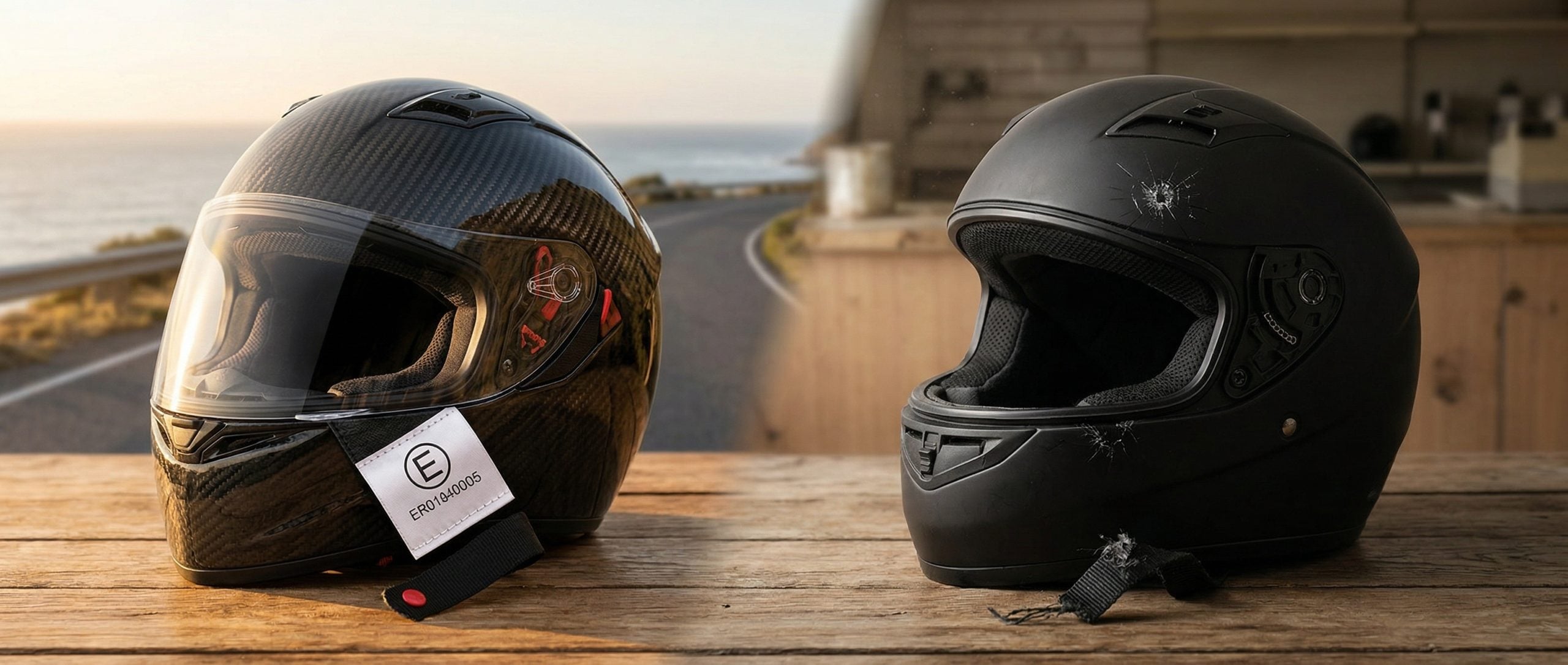
Within the vast, thrilling, and deeply passionate universe of motorcycling, where the intoxicating, adrenaline-fueled sensation of raw freedom seamlessly merges with the constant, terrifying exposure to the harsh natural elements and the unpredictable, inherent dangers of modern road traffic, there physically exists only one single, truly vital barrier standing resolutely between the fragile human brain and the unforgiving, abrasive concrete asphalt: the motorcycle helmet. However, a proper helmet is absolutely not merely a shiny piece of molded plastic tightly stuffed with pressed foam, shallowly designed strictly to casually deflect the rushing wind from your face or to proudly exhibit an aggressive, highly stylish visual graphic on the weekend. A genuine, life-saving motorcycle helmet is a highly complex, meticulously engineered piece of advanced passive safety equipment, representing the brilliant culmination of decades of deep scientific research heavily rooted in human biomechanics, exotic materials physics, and advanced fluid dynamics. But exactly how can the average, everyday rider, standing confused before massive dealership shelves overflowing with dozens of different brands and complex models, or while endlessly navigating through vast, chaotic online marketplaces, be absolutely, 100% certain that the specific piece of equipment they are about to strap securely onto their head will genuinely and successfully save their physical life during a catastrophic, high-side impact occurring at 100 km/h?
The definitive, undeniable answer lies firmly and entirely within one single, incredibly rigorous, and highly fundamental legal word: Homologation (or Certification).
In this incredibly exhaustive, deeply technical, and highly comprehensive guide, we will surgically dissect precisely what the complex certification of a helmet actually, scientifically means. We will deeply explore the brutal, highly destructive impact tests these helmets are relentlessly subjected to inside secretive European testing laboratories, actively teach you exactly how to clearly decipher the hidden, coded legal labels sewn inside the liner, and aggressively warn you regarding the terrifying, deadly, and highly prevalent dangers of the cheap counterfeits that massively flood today’s digital global market. Whether you are a hardened, highly experienced road veteran boasting decades of touring miles, or simply an excited tourist actively looking for a reliable, safe motorcycle rental service to joyfully explore the sunny southern coastline over a relaxing long weekend, acquiring this specific, deep technical knowledge is quite literally a serious matter of life and death.
1. The Complex Science of Impact: Exactly What Does a Helmet Actually Do?
To truly value and deeply appreciate the tiny homologation sticker printed on the back of the helmet, we must first profoundly understand the brutal biomechanics and chaotic physics actively occurring during a terrifying motorcycle accident. When the unprotected head of an unfortunate rider violently strikes a solid, unyielding obstacle (such as a metal guardrail or a heavy car bumper), two highly distinct, simultaneously destructive physical phenomena instantly occur within milliseconds. The first is the massive linear impact (the sudden, violent deceleration and total stopping of the hard skull). The second, and frequently the most terrifyingly lethal of the two, is the rotational impact (the head naturally suffers a highly violent, rapid twisting motion that aggressively forces the soft brain to violently rotate and bounce inside the rough interior of the skull, brutally tearing vital, delicate blood vessels and microscopic neural connections, directly resulting in the terrifying, often fatal condition known medically as Diffuse Axonal Injury).
A properly homologated, highly engineered helmet is specifically designed and meticulously built to successfully mitigate and rapidly absorb these two massive forces in a very specific, calculated manner. The tough exterior outer shell (frequently manufactured from advanced thermoplastic polycarbonate, heavy-duty fiberglass composite, pure aerospace-grade carbon fiber, or highly tensile Kevlar weaves) has the absolute primary, vital mission to forcefully resist the sharp penetration of pointed, jagged road objects and successfully distribute the massive, concentrated kinetic force of the initial, brutal point impact rapidly over a much wider, larger physical surface area. The true, unsung “hero” hidden deep inside the helmet, however, is the thick, dense interior liner manufactured from EPS (Expanded Polystyrene). Contrary to popular, incredibly naive public belief, this vital EPS liner is absolutely not a soft, comfortable memory sponge designed for luxury seating; it is a highly technical, sacrificial material meticulously engineered to aggressively crush, crack, and irreversibly deform in a highly calculated, mathematical manner during a severe crash. By effectively destroying itself, it successfully absorbs the massive, lethal kinetic energy of the brutal impact, drastically reducing the terrifying G-force transmitted to the soft, delicate human brain down to safely survivable levels (typically required to remain strictly below the crucial 275 G threshold, according to strict European laws). A fake, non-homologated helmet, or a cheap, highly illegal counterfeit replica, will simply and stupidly utilize brittle, cheap, recycled bucket plastics that instantly and violently shatter into sharp shrapnel at the exact moment of heavy impact. Their soft, useless cosmetic interior “sponges” will instantly bottom out, directly and terrifyingly transferring 100% of the massive, highly destructive crash force directly into the rider’s fragile skull.
2. The Absolute European Gold Standard: ECE 22.05 and the Radical ECE 22.06 Revolution
Across the vast continent of Europe, the strict homologation of motorcycle helmets is absolutely not a mere, friendly suggestion offered by safety organizations; it is a highly strict, fiercely enforced federal law deeply governed and meticulously regulated by the United Nations Economic Commission for Europe (UNECE). For nearly two long, highly successful decades, the absolute gold standard that effectively governed and policed the physical safety of millions of European motorcyclists was the famous ECE 22.05 standard. In order for a specific helmet model to proudly receive this highly coveted seal of approval, manufacturers were legally forced to submit large, random production batches directly to independent, highly certified testing laboratories. Deep inside these facilities, the helmets were ruthlessly frozen down to a brittle -20°C, heavily baked in ovens up to 50°C, deeply submerged completely underwater, massively exposed to highly intense, degrading UV rays, and subsequently, violently dropped in free-fall from specific, highly regulated heights directly onto solid, unyielding flat and wedge-shaped steel anvils.
However, as medical science and advanced accident telemetry slowly evolved over the years, safety engineers discovered a terrifying truth. They conclusively proved that real-life road impacts practically never occur at perfectly perpendicular, 90-degree straight angles (which is precisely what the old, simplistic laboratory drop tests simulated). In the harsh reality of the unpredictable road, sliding motorcyclists invariably hit the asphalt and obstacles at oblique, glancing angles, generating the terrifying, previously mentioned lethal rotational twisting forces.
Because of this profound, life-saving discovery, the brand new, incredibly rigorous, and highly revolutionary ECE 22.06standard recently entered into strict legal force across the continent. A helmet proudly carrying the new 22.06 homologation has successfully endured incomparably more brutal, highly complex laboratory torture tests. The brand new standard strictly mandates violent impact testing on 18 completely different, highly specific points surrounding the helmet shell (massively up from the old standard of merely 6 fixed, predictable points), effectively guaranteeing that there are absolutely zero hidden “weak spots” or fragile zones in the protective shell. Furthermore, highly specific low-speed impact tests were effectively introduced (to successfully guarantee that the heavy helmet shell is not overly, excessively rigid, ensuring it properly absorbs minor, frequent urban bumps without transferring the shock to the head), alongside tests at vastly higher terminal velocities. However, the absolute greatest, most monumentally crucial alteration in the law was the strict, mandatory introduction of the oblique (rotational) impact drop test. This specific, complex test drops the helmet onto a 45-degree angled anvil coated in abrasive material, rigorously evaluating and recording the exact quantity of highly destructive twisting force that the sliding helmet tragically allows to be violently transmitted directly to the rider’s neck and brain. In addition to shell testing, the clear optical visors are now aggressively tested against the violent impact of solid, heavy steel spheres violently fired from air cannons at speeds well exceeding 200 km/h to accurately simulate the terrifying impact of kicked-up road debris, ensuring the rider’s delicate eyes remain fully shielded and uninjured behind the plastic.
3. How to Properly Read and Decipher the Complex Homologation Label
Merely knowing that the strict ECE safety standard exists is only the very first, basic step; the true, ultimate power of the informed consumer deeply resides in actually knowing exactly how to physically read and interpret the legal physical proof that the specific helmet you currently hold in your bare hands has successfully passed these brutal torture tests. Every single legal, properly homologated helmet currently sold and actively utilized within Europe is legally, absolutely required to feature a highly specific homologation label permanently, heavily sewn directly onto the helmet’s retention strap (the tough nylon webbing that tightly fastens the helmet securely underneath your chin). This small, unassuming white label contains a highly complex series of letters and numbers that actively tell the complete, unabridged legal and physical history of that specific piece of safety equipment.
The complex label will absolutely always prominently feature a large, bold circle containing a capital letter “E” directly inside it, immediately followed by a specific number. This is the official, international legal mark of approval.
- The “E” (Europe): This capital letter strictly indicates that the helmet fully, legally complies with the highly demanding, stringent safety regulations established by the UNECE.
- The Specific Number firmly beside the “E”: This specific numerical digit clearly indicates the exact, specific European country whose official Ministry of Transport (or its highly certified equivalent national testing laboratory) actively issued, tested, and legally attested to the final homologation. For example: E1 legally signifies Germany, E2 signifies France, E3 signifies Italy, E4 signifies the Netherlands, E9 signifies Spain, E11 signifies the United Kingdom, and the list continues. A helmet proudly bearing the E9 mark (tested in Spain) holds the exact same, absolute legal validity and provides the exact same stringent guarantee of extreme safety when worn in Portugal as a helmet bearing the E3 mark (tested in Italy).
- The Long Alphanumeric Sequence Directly Below the Circle: This long string of digits is the absolutely vital, highly specific identification code.
- If this long numerical sequence begins exactly with 05, it clearly means that the helmet model was originally homologated and tested strictly under the old, outgoing ECE 22.05 standard.
- If the sequence begins proudly with 06, it actively celebrates the brand new, vastly more secure, and incredibly rigorous ECE 22.06 standard.
- The long series of random numbers that directly follows the prefix is the specific, unique legal approval serial number for that exact helmet model (acting effectively as a sort of unique, traceable laboratory identity card or passport for the helmet design).
4. The Highly Crucial Suffix: Deciphering J, P, NP, or PJ
Immediately following the incredibly long, complex approval serial number, you are going to discover one or two absolutely crucial, highly revealing capital letters printed on the tag. These specific letters accurately and legally indicate the exact, specific physical type of facial protection that the helmet legally offers, particularly regarding the highly vital, highly exposed lower jaw and chin zone.
- The Letter “J” (Jet): This specific letter clearly indicates that the helmet model absolutely does not feature a structural, protective lower chin bar. It is an open-face helmet (frequently utilized by riders on slow urban scooters or owners of stylish, classic vintage motorcycles). It legally, willingly leaves your entire face, nose, and jawbone totally exposed to devastating frontal impacts.
- The Letter “P” (Protective): This vital letter strongly indicates that the helmet proudly possesses a structurally sound, highly integrated, and rigid front chin guard that was heavily subjected to, and successfully passed, the incredibly rigorous, violent frontal impact drop tests in the laboratory. This is the standard designation you will absolutely always find firmly printed on the tags of massive, full-face, closed sports touring and racing helmets.
- The Letters “NP” (Non-Protective): This is a highly rare, unusual classification occasionally found on some older, strange helmet designs featuring fully removable chin bars or older, poorly designed modular helmets. It legally indicates that while a physical plastic chin bar is visibly present on the helmet, it horribly failed the strict laboratory impact test and therefore absolutely does not offer any genuine, real structural protection to the jaw during a real crash.
- The Letters “PJ” (Protective / Jet): This specific, highly coveted double homologation is massively sought after by thousands of enthusiastic touring and adventure motorcycle riders. It is commonly found exclusively on the absolute best, premium modular flip-up helmets (the specific models where the entire front face and visor section hinges upwards). It legally and physically means that the helmet was rigorously, heavily tested and successfully approved to be legally ridden both fully closed and locked down (offering full, maximum “P” integral facial protection) and ridden completely open (acting effectively as a breezy “J” Jet helmet), featuring a complex internal mechanism that firmly locks the heavy upper shell in the open position so it cannot dangerously, violently snap down like a guillotine due to highway wind pressure. Riding on the highway with an open modular flip-up helmet that unfortunately does not possess the strict “PJ” double homologation is not only incredibly stupid and massively dangerous during an accident, but from the strict legal perspective of the European highway code, it is totally illegal and will rapidly earn you a massive, heavy financial traffic fine if caught by the police.
5. Navigating Other Global Standards and Independent Rating Bodies
Although the strict ECE standard remains the absolute sovereign, undisputed law of the land across the entire European continent, highly informed, global-minded motorcyclists frequently and confusingly encounter several other prominent acronyms in the vast global market, especially when eagerly reading international helmet reviews online or attempting to purchase cheaper products imported directly from the United States.
- DOT (Department of Transportation – FMVSS 218): This is the basic, absolute minimum legal safety standard heavily required to sell a helmet within the vast United States. The massive, deeply terrifying fundamental difference when compared to the strict European standard is that the American DOT system functions entirely on a heavily flawed system of “honor and manufacturer self-certification.” The helmet manufacturer essentially conducts their own private, secretive, unverified drop tests inside their own factory and then happily slaps the official “DOT” sticker on the back of the helmet shell before shipping it. The US government merely conducts highly random, infrequent batch testing in independent labs months later. Historically, massive numbers of cheap, imported helmets proudly bearing the DOT sticker have utterly and catastrophically failed subsequent, independent safety tests. This is exactly why, throughout continental Europe, a helmet possessing exclusively a DOT sticker (without the ECE label) is completely, legally invalid and strictly forbidden for road use.
- SNELL (Snell Memorial Foundation): This is a strictly voluntary, extremely aggressive, and highly respected independent testing standard operating in the USA. It was originally, emotionally founded following the highly tragic, fatal racing crash of popular sports car driver Pete Snell, whose vital legacy is tirelessly preserved and honored by the Snell Foundation. Snell aggressively tests helmets focusing heavily on incredibly high-energy impacts, which frequently results in approved helmets possessing a significantly stiffer, much harder outer shell (often highly favored by track racers).
- FIM (Fédération Internationale de Motocyclisme): This is currently the absolute highest, most elitist, and most demanding safety standard existing on the entire planet. Developed specifically for the brutal, terrifying, and violent speeds found strictly within elite international motorsport via the FIM Racing Homologation Programme, this homologation is now absolutely mandatory for all helmets utilized in the world championships of MotoGP and World Superbikes. It focuses incredibly heavily on the extreme prevention of severe oblique, high-speed rotational impacts. If your personal, incredibly expensive carbon fiber helmet features a tiny FRHPhe holographic sticker, you are quite literally, proudly wearing world-class, multi-million dollar elite racing technology on your head.
- SHARP (Safety Helmet Assessment and Rating Programme): This is a truly brilliant, highly informative, and independent safety initiative heavily funded by the UK government, accessible globally via the SHARP portal. SHARP absolutely does not replace the mandatory legal ECE standard; rather, the program takes helmets that have already successfully passed European homologation, secretly and anonymously purchases them off the shelves in normal retail stores like a regular customer, and subsequently subjects them to an incredible 32 additional, highly brutal impact tests to assign them a clear, independent consumer rating ranging from a poor 1-star up to a flawless 5-star rating. It is the absolute perfect, invaluable tool for highly confused consumers attempting to break a tie between two beautifully designed, legally homologated helmets.
6. The Terrifying, Deadly Threat of Online Counterfeit Fakes
Deep within the modern, highly digitized era of globalized e-commerce, incredibly cheap, unregulated oriental sales platforms and obscure websites are massively flooded with highly dangerous, fake helmets. These counterfeits look incredibly shiny, highly aggressive, and brazenly sport the iconic colors and stolen logos of world-famous, premium premium helmet brands—all offered at a tiny, incredibly tempting fraction of the authentic retail price. Choosing to purchase and wear one of these cheap, fraudulent helmets is, in harsh practical reality, the exact equivalent of blindly playing a terrifying game of Russian roulette with your own brain.
These illegal, highly dangerous counterfeit helmets absolutely do not utilize meticulously calibrated, highly engineered EPS foam to effectively absorb massive kinetic energy, nor do they feature complex, layered polycarbonate or heavy-duty fiberglass shells. Instead, their illicit manufacturers wildly utilize low-grade, recycled garbage plastics (structurally highly similar to the brittle plastics used to manufacture cheap household trash cans) and useless, soft cosmetic sponges inside. In the terrifying event of a real-world, violent accident occurring at a mere 50 km/h, while a genuine, homologated helmet masterfully compresses internally to gracefully absorb the deadly kinetic energy, the rigid, brittle plastic shell of a fake helmet frequently and violently shatters into razor-sharp pieces exactly like the shell of a fragile egg the very millisecond it forcefully strikes the unforgiving concrete. The rider’s unprotected skull then violently strikes the shattered, jagged remains of the rigid plastic shell and the hard asphalt with total, devastating, and unfiltered lethal force. Furthermore, the clear visors heavily installed on these fake helmets, instead of effectively and safely deflecting heavy flying rocks or massive insects, are absolutely not manufactured from highly flexible, shatter-resistant polycarbonate. When violently struck by a stone, they shatter easily and instantaneously into dozens of razor-sharp shards of flying plastic directed directly into the rider’s eyes and face, frequently causing horrific, permanently blinding, and irreversible facial injuries.
How to quickly and accurately identify a highly dangerous fake counterfeit?
- The total, suspicious absence of the white ECE label stitched onto the strap: Lazy counterfeiters frequently and happily slap a shiny, fake sticker on the back of the helmet shell proudly displaying the letters “DOT” or “ECE”, but they consistently forget, or cheaply avoid the manufacturing cost of, physically stitching the mandatory, complex alphanumeric white fabric tag (bearing the E1, E3, etc. codes) directly onto the chin strap.
- The cheap chin strap buckle and the suspiciously low weight: Fake, illegal helmets heavily utilize incredibly low-quality, brittle plastic buckles that simply pop open or physically fall apart if you pull on the straps aggressively with your bare hands. Additionally, their total lack of complex, dense structural safety materials frequently makes them feel suspiciously, incredibly light and flimsy when held.
- Gross, obvious spelling errors or deliberate brand deviation: Look incredibly closely at the graphics. You will frequently spot poorly printed, blurry logos or the names of world-famous premium brands featuring slightly swapped or missing letters (a common, cheap legal trick utilized in certain Asian factories to successfully avoid direct, blatant international copyright infringement lawsuits while still tricking the naive consumer).
- The Miraculous, Unbelievable Price Tag: A genuine, authentic full-face helmet manufactured from real, aerospace-grade carbon fiber costs several hundreds of euros just to produce in the factory. It deeply encompasses dozens of highly expensive hours of advanced aerodynamic engineering and heavily involves specialized, meticulous manual molding and curing processes. If you happen to stumble upon a brand new “carbon fiber” racing helmet for sale online boasting a miraculous price tag of a mere 50 or 80 euros, you are undeniably, 100% staring at a cheap piece of brittle, dangerous plastic heavily painted and deceptively decaled to look like something it absolutely is not.
7. The Rental Factor: Demanding Absolute Safety on Your Vacation
Unfortunately, it is precisely during those highly sought-after, relaxing moments of deep holiday relaxation and carefree detachment that a massive number of otherwise careful, highly diligent motorcyclists completely lower their strict, uncompromising safety standards. This happens especially frequently when eager tourists travel to exotic, tropical destinations in Asia, remote parts of Africa, or even when visiting highly popular, busy coastal tourism zones located throughout the sunny southern coast of continental Europe. When eagerly walking into a small, highly obscure, and poorly reviewed local agency aiming to secure a quick, cheap motorcycle rental, the overwhelming emotional temptation to simply grab the very first, dirty helmet casually offered by the clerk—which is frequently an incredibly old, heavily worn-out piece of equipment featuring severely frayed chin straps, foul-smelling interiors, and a deeply scratched, cloudy visor—just so you can finally, quickly hit the road and reach the beautiful beach as fast as humanly possible, is utterly immense.
This is an absolutely colossal, potentially fatal error in judgment. Absolutely never permit your joyful holiday enthusiasm or your rush to the beach to foolishly cloud your primal, fundamental instinct of self-preservation. When dealing with a questionable, cheap rental agency, the supposedly “free” helmet casually provided with the scooter might very well be a highly dangerous, illicit counterfeit piece acquired for literal pennies by a highly unscrupulous, greedy owner looking to massively maximize their profit margins. Alternatively, it might be an incredibly old, genuine helmet that has already tragically suffered numerous severe drops onto the concrete pavement or invisible, massive shocks from previous renters crashing. These heavy, previous impacts have already completely and irreversibly compromised the internal structural integrity of the highly vital EPS shock-absorbing foam hidden inside, effectively leaving the helmet completely, utterly useless from the strict standpoint of absorbing any future lethal kinetic energy. You possess the sacred, absolute legal, and physical duty to your own body to carefully, meticulously inspect the nylon chin strap and actively, aggressively search for the vital, mandatory white tag prominently featuring the ECE circle. If that vital tag absolutely does not exist, or if the safety equipment is clearly in a severe, horrifying state of visible structural degradation and decay, you must firmly, unequivocally refuse to proceed with the transaction. For those embarking on significantly longer, more serious touring journeys, or for highly cautious, intelligent tourists who deeply value their brains, the absolute supreme, golden recommendation is to always, without fail, bring your own highly trusted, personally fitted, homologated helmet with you onto the airplane as carry-on luggage. Alternatively, you must strictly and exclusively utilize the premium services of highly rigorous, deeply trustworthy, and highly rated rental companies where the massive, meticulous, and impeccable maintenance heavily applied to their fleet of motorcycles flawlessly and uncompromisingly extends directly to the high-quality human safety equipment they proudly provide to their valued clients.
8. The Hidden Expiration Date: Helmets Absolutely Expire Too
A completely authentic, perfectly legal, and highly premium helmet proudly bearing the absolute latest, cutting-edge 22.06 homologation standard naturally possesses a highly specific, technical safety validity lifespan, and the shocking negligence of this harsh physical reality constantly surprises and endangers many highly experienced, veteran riders. Even if your pristine, shiny helmet has absolutely never, ever physically touched the rough asphalt or tragically suffered a severe, lethal racing accident, it possesses exactly what the safety industry strictly refers to as a “laboratory shelf life,” which is frequently, heavily fixed at roughly five short years starting from the exact date of initial, active road use, or a strict seven years starting from the exact, stamped manufacturing date hidden under the comfortable interior foam liner.
The strict, uncompromising underlying reason for this expiration is purely and deeply grounded in complex chemical science. The highly precious, life-saving interior layer of Expanded Polystyrene (EPS) foam slowly, insidiously, and naturally degrades, hardening over the relentless passage of time and years. This invisible, dangerous chemical degradation process is heavily and terribly accelerated by the highly corrosive daily residues of human perspiration (which contains aggressive organic acids and corrosive mineral salts), the natural, greasy oils constantly secreted by your hair, common chemical cosmetic products, and the deep, continuous thermal shocks of shifting from scorching summer heat to freezing winter rides. In addition to this internal decay, the crucial, hard outer shell (specifically if manufactured from standard thermoplastic) gradually, painfully dries out and becomes highly brittle due to the continuous, intense, and heavily punishing exposure to the harsh Ultraviolet (UV) rays continuously emitted by the sun, rendering it considerably weaker, highly fragile, and incredibly prone to shattering upon impact after half a decade of heavy, continuous, daily road use. Finally, absolutely never, ever forget the strict, golden, number-one rule established heavily by every single global helmet manufacturer: if your personal helmet was violently exposed to a massive, severe impact during an unfortunate, violent traffic accident, or even forcefully dropped from a high table directly onto hard concrete, even if the exterior, shiny paint job miraculously appears to have merely suffered a tiny, insignificant cosmetic scratch and there absolutely exists zero obvious, visible fracture or cracking on the visual surface, the highly precious, hidden EPS interior of the shell that successfully, ingeniously crushed precisely as planned to save your physical life absolutely does not possess the magical capability to slowly recover its initial, protective three-dimensional form. The helmet has faithfully, heroically rendered its absolute final, and most magnificent, life-saving service to humanity; it is now structurally compromised in its very essence and must be summarily, irreversibly destroyed, the straps aggressively cut with heavy scissors to prevent reuse, and thrown directly into the garbage.
9. Your Next Highly Intelligent Decision
Understanding in meticulous, deep detail the massive, heavy, and highly complex bureaucratic and strict legal language surrounding the ECE homologation process actively guarantees that you not only get to deeply, joyfully enjoy the sublime, wind-in-your-face purity of the open road and the breathtaking, sprawling coastal landscapes, but that you also, inevitably and happily, manage to return completely unscathed and perfectly safe to your home, ready to peacefully embrace your beloved family and children at the very end of the longest, most physically grueling day of a massive touring epic. The tiny, unassuming white sticker proudly sewn inside your helmet is absolutely not your mere, annoying physical passport demanded by cruel, strict traffic law authorities during a random, frustrating police stop; it is your incredibly solid, fundamental physical and mechanical guarantee, acting as your ultimate, unwavering protective guardian angel during those terrifying, chaotic, and dangerous tenths of a second when absolutely everything in your life suddenly and catastrophically goes horribly wrong on the road, and the brutal, unforgiving law of physical inertia completely dominates the environment.
And if you eagerly intend to boldly venture out on a fantastic, breathtaking tourist ride and actively, deeply experience this overwhelming, premium safety enveloped in total, plush comfort and profound, unshakeable confidence, absolutely do not risk your life or foolishly attempt to save mere pennies when navigating the highly crucial choice and rigorous selection of your preferred vehicle agency. Strictly rely upon and exclusively utilize highly certified, properly licensed, and deeply structured services that fiercely view the rigorous, meticulous maintenance of the absolute best human safety equipment and the most modern, flawless motorcycles as their absolute, non-negotiable primary rule and fundamental law of honor.
Whenever you desperately need to secure a safe, highly reliable, and fantastic motorcycle rental to enjoy total, unbridled freedom while exploring the sunny, winding roads of the beautiful Portuguese territory, always actively, smartly avoid the false, vulgar, and highly deceptive cheap exotic appearances frequently offered by shady street vendors. Instead, heavily focus your rigorous, intelligent online research exclusively on discovering genuine, world-class safety and internationally renowned quality. Start right now and meticulously plan your highly exciting, luxury travel journey directly with us, and easily find the absolutely perfect, heavily tested, and highly homologated equipment that has consistently, proudly protected multiple generations of demanding motorcyclists across the national territory. Visit today and actively, confidently reserve your life in total tranquility through the highly secure, incredibly transparent digital platform of RENT.MOTO.pt, the massive, premier Portuguese portal specifically designed and heavily focused on your supreme, ultimate physical protection. We cater extensively not only to exotic, high-end tourist rentals but also proudly serve as your fundamental, daily, and highly secure point of contact regarding the complex areas of selling, commercial management, and purchasing within the absolute best, most prestigious world of high-end automobiles and premium motorcycles. Equip yourself rigorously and perfectly with RENT.MOTO.pt, and fully, joyfully enjoy the open road with the absolute best machines on the market, riding proudly in a spirit of authentic, lethal armor against absolutely all risks and unpredictable bad weather that may ever dare to cross your fantastic, thrilling path on two wheels!